
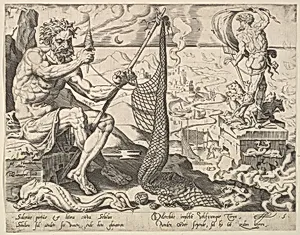
Zebulun, from the series The Twelve Patriarchs
Medium
Etching; second state
Dimensions
Sheet: 8 5/16 x 10 5/8 in. (21.1 x 27 cm)
Classification
Prints
Department
Drawings and Prints
Museum
Metropolitan Museum of Art, New York, NY
Credit
The Elisha Whittelsey Collection, The Elisha Whittelsey Fund, 1949
Accession Number
49.95.117
Rights
Public Domain
Tags
Art Historical Context
"Zebulun, from the series *The Twelve Patriarchs*" is a striking 1550 etching by Dutch Renaissance artist Maarten van Heemskck, with engraving assistance from Dirck Volckertsz Cohert. This second-state impression captures one of the twelve sons of the biblical Jacob, whose tribes formed the foundation of ancient Israel. Produced during the Northern Renaissance in the Netherlands, the print reflects the era's fascination with classical antiquity and biblical narratives, blending religious devotion with emerging artistic innovation. The image features a muscular male nude figure of Zebulun, associated in Genesis with seafaring and maritime havens, surrounded by symbolic fish that evoke his tribal destiny as a haven for ships. Van Heemskerck's Mannerist style shines through in the elongated forms, dynamic poses, and intricate details, hallmarks of his shift from Italianate influences gained during his Roman travels. Coornhert's precise etching and engraving techniques allowed for rich tonal contrasts and fine lines on the 8 5/16 x 10 5/8 in. sheet, making complex compositions accessible via affordable prints. As part of a complete series now housed in The Metropolitan Museum of Art's Elisha Whittelsey Collection, this work highlights printmaking's role in 16th-century visual culture—disseminating art to a wider audience amid religious upheavals. It's a testament to collaborative artistry and the enduring power of biblical iconography in Renaissance Europe.