
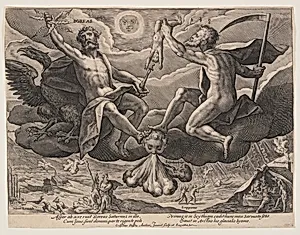
Boreas, from The Winds
c. 1603
Medium
Engraving on ivory laid paper
Dimensions
Sheet (trimmed): 17.1 × 22.3 cm (6 3/4 × 8 13/16 in.)
Classification
engraving
Department
Prints and Drawings
Museum
Art Institute of Chicago
Accession Number
267908
Rights
Public Domain
Art Historical Context
**Boreas, The Winds** *ispijn van de Passe, c. 160* Engraving ivory laid paper, Sheettrimmed): 171 × 22. cm Step into the world of early 17th-century Dutchmaking with Crispijn van de Passe's enchanting engraving *Boreas, from The Winds*. Created around 1603, this work is part of a series personifying the classical winds, drawing from Greek mythology where Boreas embodies the fierce North Wind. Van de Passe, a masteraver from a renowned family of Antwerp artists, captures the era's fascination with allegory and nature's powers during the Dutch Golden Age's early stirrings, when prints like this democratized art for a wide audience beyond paintings. Engraving on delicate ivory laid paper highlights van de Passe's virtuosity: the intaglio technique allowed for intricate lines and tonal depth, with the paper's subtle texture enhancing the wind-swept drama. Trimmed to a compact 17 x 22 cm, it was ideal for collectors' albums or scholarly study, reflecting printmaking's role in preserving and sharing mythological motifs across Europe. Housed in the Art Institute of Chicago's Prints and Drawings collection, this piece showcases how engravings bridged Renaissance humanism and Baroque exuberance, inviting us to feel Boreas's chill breath through masterful precision. A testament to art's power to harness the invisible!
About the Artist
Crispijn van de Passe, I · 1565–1637
Crispijn van de Passe the Elder, born around 1564 in the coastal town of Arnemuiden in Zeeland, emerged as a pivotal figure in Northern European printmaking during a turbulent era. He relocated to Antwerp at a young age, the bustling epicenter of engraving, where he trained and worked from 1580 onward, becoming a member of the Guild of Saint Luke in the 1584–1585 guild year. The Spanish siege and ...