
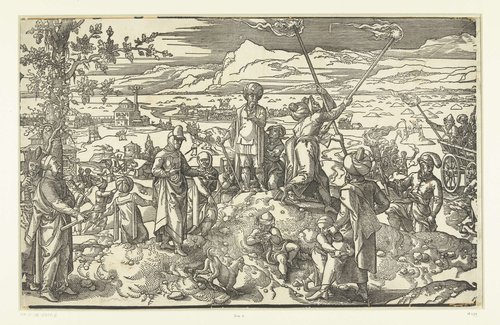
Zeden en Gewoonten der Turken
Medium
paper
Dimensions
292; 465
Rights
Public Domain
About this artwork
height 292 mm x width 465 mm
Art Historical Context
Pieter Coecke van Aelst’s *Zeden en Gewoonten der Turken* (Customs and Habits of the Turks), created in 1553, offers a fascinating glimpse into sixteenth-century European fascination with the Ottoman Empire. Working in the Flemish Renaissance tradition, Coecke van Aelst produced this work on paper as a series of prints that documented Turkish daily life, costumes, and ceremonies. The modest dimensions—roughly 29 by 46 centimeters—suggest it was designed for wide circulation, allowing viewers across Europe to encounter cultures beyond their borders through detailed observation rather than fantasy. The choice of paper as a medium was significant in an era when prints served as both art and information. Coecke van Aelst, who had traveled to Constantinople years earlier, translated his firsthand experiences into accessible images that combined careful draftsmanship with an ethnographic eye. These sheets helped shape how Northern European audiences visualized the powerful Ottoman world at a time of both political tension and cultural exchange. Today the work stands as an early example of cross-cultural documentation in print form, valued for its blend of artistic skill and historical testimony. Its survival on paper reminds us how such images traveled widely, influencing later generations of artists and scholars interested in the lands of the eastern Mediterranean.