
Zegenende Christus
1455 - 1503
Medium
engraving
Dimensions
72; 125
Rights
Public Domain
About this artwork
gravure
Art Historical Context
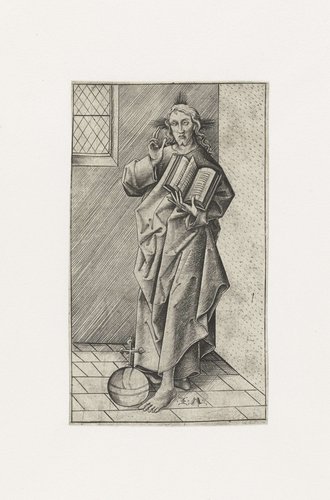
Behold the *Zegenende Christus*Blessing Christ), a delicate engraving by Israhel van Mecem, a prominent German printmaker active between 1455 and 1503. Measuring just 125 mm high by 72 mm wide, intimate work captures Christ raising his hand in benediction, embodying the devotional piety of late 15th-century Northern Europe. Van Meckenem, based in the Rhineland town that bears his name, was a master of the engraving technique, which allowed artists to produce multiple impressions from a single copper plate—a revolutionary method that democratized religious imagery for laypeople beyond the elite. Created during the Northern Renaissance, this piece reflects the era's emphasis on intricate detail and spiritual directness, influenced by earlier engravers like the Master E.S. The fine, cross-hatched lines van Meckenem employed create subtle shading and texture, bringing Christ's serene expression and flowing robes to life on paper. Such small-scale prints were prized for private prayer, often pasted into books of hours or displayed in homes, making sacred art accessible amid the growing market for affordable devotional objects. Van Meckenem's output, numbering over 600 engravings, highlights the dawn of printmaking's golden age, bridging manuscript illumination and the later woodcut explosion sparked by Dürer. This modest yet masterful *Zegenende Christus* invites visitors to appreciate how a tiny image could inspire profound faith.
About the Artist
Israhel van Meckenem · 1435–1503
Israhel van Meckenem (c. 1445–1503), also known as Israhel van Meckenem the Younger, was a pioneering German engraver and goldsmith based in Bocholt, near the Dutch border, renowned as the most prolific printmaker of the fifteenth century. Born into a family possibly of Dutch origin, he was the son of Israhel van Meckenem the Elder, a goldsmith who settled in Bocholt in 1457. He trained initially ...