
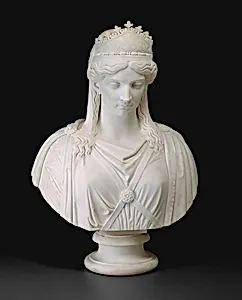
Zenobia, Queen of Palmyra
modeled c. 1859; carved after 1859
Medium
Marble
Dimensions
86.4 × 57.2 × 31.8 cm (34 × 22 1/2 × 12 1/2 in.)
Classification
sculpture
Department
Arts of the Americas
Museum
Art Institute of Chicago
Accession Number
125652
Rights
Public Domain
About this artwork
Zenobia was queen of the Syrian city of Palmyra and ruled it after her husband’s death in the third century. Harriet Hosmer portrayed Zenobia at the moment of her capture and defeat by the Roman emperor Aurelian in 272 CE. Rather than depict a scene of heightened drama, the sculp-tor opted for a quieter sense of grandeur, remarking, “I have tried to make her too proud to exhibit passion or emotion of any kind; not subdued, though a prisoner; but calm, grand, and strong within herself.” Hosmer w...
Art Historical Context
Harriet Hosmer’s *Zenobia, Queen of Palmyra* captures the dignity of a remarkable historical figure. Zenobia ruled the oasis city of Palmyra in the third century and briefly challenged the Roman Empire, expanding her realm across the eastern Mediterranean before her defeat. Hosmer, one of the first professional American women sculptors, modeled the work around 1859 and had it carved in marble shortly afterward, presenting the queen in quiet strength rather than dramatic defeat. Carved from luminous white marble, the sculpture reflects the neoclassical taste of its era while showcasing Hosmer’s technical skill in rendering draped fabric and a composed expression. At just over two feet tall, the intimate scale invites close viewing, allowing visitors to appreciate the subtle folds of Zenobia’s robe and the regal tilt of her head. As a work by an American artist active abroad, it also speaks to the growing international presence of women in the fine arts during the nineteenth century. Today housed in the Art Institute of Chicago’s collection of American sculpture, *Zenobia* stands as both a portrait of ancient resilience and a testament to Hosmer’s determination to succeed in a male-dominated field.