
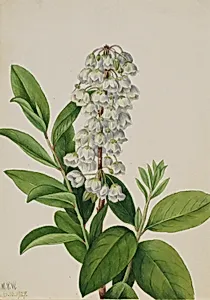
Zenobia (Zenobia cassinifolia)
Medium
Painting
Classification
Painting
Department
Smithsonian Collection
Museum
Smithsonian American Art Museum
Credit
Smithsonian American Art Museum, Gift of the artist
Accession Number
1970.355.602
Rights
Public Domain
Tags
Art Historical Context
Mary Vaux Walcott's *Zenobia (Zenobia cassinifolia)*, painted in 1927, captures the delicate beauty of this rare North American shrub, known for its glossy leaves and bell-shaped flowers. Donated by the artist herself to the Smithsonian American Art Museum, this painting exemplifies Walcott's lifelong passion for documenting wildflowers with scientific precision and artistic grace. As part of the Smithsonian Collection, it invites visitors to appreciate the intersection of botany and fine art. Walcott, a pioneering Canadian-American artist and naturalist (1860–1940), created hundreds of such works during her expeditions across the continent, often alongside her geologist husband, Charles Doolittle Walcott. Active in the early 20th century, her paintings contributed to public awareness of native flora at a time when conservation efforts were gaining momentum. This piece, rendered in traditional painting techniques, highlights her meticulous attention to detail—showcasing the plant's textured foliage and subtle hues that evoke the serenity of untamed landscapes. Today, *Zenobia* stands as a testament to women's roles in science and art during the interwar period, blending education with aesthetics. A gentle reminder of nature's fragility, it encourages museum-goers to marvel at how a single bloom can bridge disciplines and eras. (198 words)