
Zeven rolwagens
c. 1635 - c. 1650
Medium
turning
Dimensions
14.7; 45.2
Rights
Public Domain
About this artwork
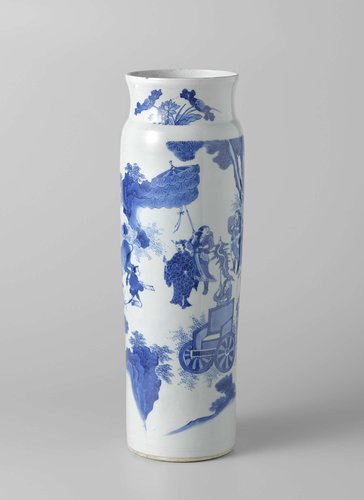
Cilindrische vaas met een vlakke ongeglazuurde bodem en met een wijde uitlopende mond. Beschilderd in onderglazuur blauw met een ontmoeting tussen een hoogwaardigheidsbekleder en een ossenherder. In het gevolg van de hoogwaardigheidsbekleder vlaggen- en baldakijndragers en een rolstoel. Rond de hals twee bloemtakken. Waarschijnlijk is de ontmoeting afgebeeld tussen de mytische koning Yao en de kluizenaar Xu You.
Art Historical Context
**Zeven rolwagens** is a striking cylindrical vase from China's late Ming dynasty, dating to around 1635–1650. Standing at 45.2 cm tall with a diameter of 14.7 cm, it features a flatazed base and a wide, flaring mouth. Crafted anonymously using wheel-turning techniques, the vase showcases the precision of traditional pottery methods from Jingdezhen, the epicenter of porcelain production. Adorned in vibrant underglaze blue, body depicts a serene encounter between a high-ranking officiallikely the mythical Emperor Yao—and a humble ox herder, the hermit Xu You. Yao's entourage includes flag and canopy bearers, along with a distinctive wheeled chair (rolstoel), evoking themes of virtue and humility from ancient Chinese lore. Xu You famously refused the throne, symbolizing the ideal of retiring from worldly power. Delicate flower branches encircle the neck, adding poetic elegance. This transitional Ming piece highlights the artistry of blue-and-white porcelain, where cobalt pigment under transparent glaze fired at high temperatures yields enduring color. Exported widely via maritime trade, such vases captivated European collectors, blending Eastern mythology with technical mastery for timeless appeal.
About the Artist
anonymous
In the vast tapestry of art history, "Anonymous" stands not as a singular individual but as a collective designation for countless unidentified creators whose works have endured across millennia. These artists, spanning prehistoric cave painters to medieval illuminators and folk craftsmen, produced the foundational layers of human visual culture. Prior to the Renaissance, when individual fame emer...