
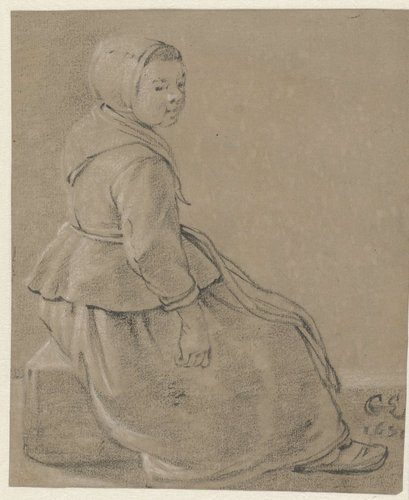
Zittend meisje
Medium
paper
Dimensions
147; 180
Rights
Public Domain
About this artwork
…; collection Carel Vosmaer (1826-88), Montreux;{Amsterdam 1989, p. 64, no. 21.} his son, Prof. Dr Gualtherus Carel Jacob Vosmaer (1854-1916), Leiden; his son, C.J.J.G. Vosmaer (1907-86), Leiden; his heirs; from whom, fl. 650,000, with 212 other drawings, to the museum, with support from the Vereniging Rembrandt, the Rijksmuseum Stichting and The Ster, 1989
Art Historical Context
Cornelis Saftleven's *Zittend Meisje* (Seated Girl), created in 1656, the intimate charm of Dutch Golden Age draftsmanship. This delicate drawing on paper, measuring just 180 × 147 mm, likely depicts a young woman in a quiet, everyday pose, reflecting Saftleven's skill in rendering human figures with sensitivity and realism. As a prominent Utrecht artist (1607–1691), Saftleven renowned for his genre scenes, peasant life, and animal studies, often executed in pen and ink or chalk on paper. His works bridge the Caravaggesque influences of his early career with the refined naturalism of the Dutch Baroque, making this small-scale piece a window into 17th-century domestic life. The drawing's artistic significance lies in its technical finesse—Saftleven's loose, expressive lines and subtle shading techniques showcase the versatility of paper as a medium for studies and finished works during the Golden Age. Such intimate sketches were prized by collectors for their immediacy, far removed from grand oil paintings. Its provenance adds intrigue: once in the esteemed collection of Carel Vosmaer (1826–1888) in Montreux, it passed through generations of his family before the Rijksmuseum acquired it in 1989, alongside 212 other drawings, for 650,000 florins. Supported by the Vereniging Rembrandt and others, this purchase underscores the enduring value of Saftleven's legacy in preserving Dutch artistic heritage.
About the Artist
Cornelis Saftleven · 1607–1681
Cornelis Saftleven (c. 1607–1681) was born in Gorinchem into a family of artists, with his father Herman Saftleven and brothers Abraham and Herman Saftleven the Younger also painters. He likely learned his craft from his father in Rotterdam, where the family was active, and later collaborated closely with his brother Herman in Utrecht around 1634, developing innovative stable interiors as a new mo...