
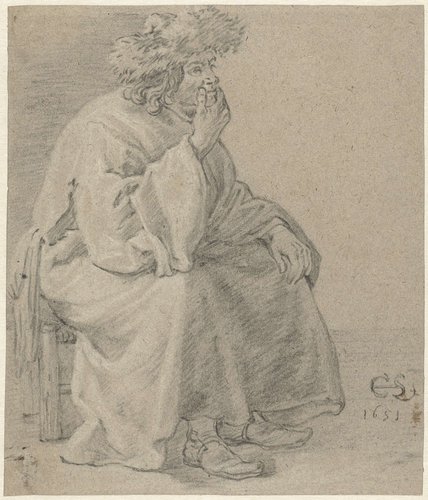
Zittende man met bontmuts
Medium
paper
Dimensions
227; 194
Rights
Public Domain
About this artwork
Aankoop met steun van de Vereniging Rembrandt, mede dankzij het Prins Bernhard Fonds, de Rijksmuseum-Stichting en De Ster Holding BV
Art Historical Context
Cornelis Saftleven's *Zittende man metmuts* (Seated Man with Fur Hat), created in 1651, a moment of quiet introspection the Dutch Golden Age. This intimate drawing on paper, measuring just 227 × 194 mm, depicts a seated figure in a fur-lined hat, rendered with Saftleven's characteristic attention to everyday character studies. As a master of the Utrecht school, Saftleven (1607–1691) excelled in genre scenes and tronies—expressive portraits of ordinary folk—blending realism with subtle psychological depth, influenced by the Baroque era's focus on light, texture, and human emotion. The use of paper as a medium highlights Saftleven's prowess in drawing, a staple of Dutch artists who prized preparatory sketches and standalone studies for their spontaneity and detail. Techniques like fine hatching and contour lines likely bring out the fur's texture and the man's weathered features, evoking the rugged life of 17th-century peasants or travelers. These works were collectible even then, valued for their unpretentious humanity amid Holland's prosperous trade era. Acquired with support from the Vereniging Rembrandt, the Prins Bernhard Fonds, the Rijksmuseum-Stichting, and De Ster Holding BV, this piece underscores its enduring cultural importance. It invites visitors to appreciate the artistry in the ordinary, a hallmark of Dutch mastery.
About the Artist
Cornelis Saftleven · 1607–1681
Cornelis Saftleven (c. 1607–1681) was born in Gorinchem into a family of artists, with his father Herman Saftleven and brothers Abraham and Herman Saftleven the Younger also painters. He likely learned his craft from his father in Rotterdam, where the family was active, and later collaborated closely with his brother Herman in Utrecht around 1634, developing innovative stable interiors as a new mo...