
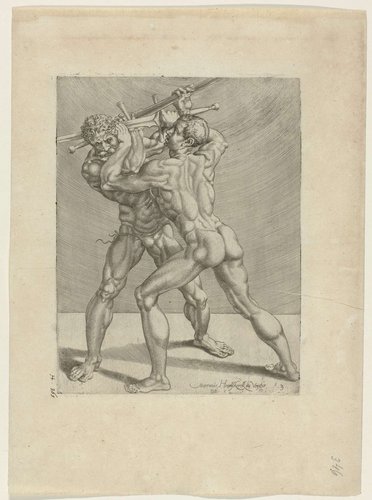
Zwaardvechters
1552
Medium
etching
Dimensions
189; 248
Rights
Public Domain
About this artwork
verzamelaarsmerk, verso midden links, gestempeld: Lugt 2760
Art Historical Context
**Zwaardvechters (Sword Fighters)** *Cornelis Bos, 1552, etching, 248 × 189 mm* Step into the dynamic world of 16th-century Netherlandish printmaking with Cornelis Bos's *Zwaardvechters*, an etching capturing the intense clash of sword-wielding figures. Created in 1552, this work exemplifies Bos's skill as a versatile Antwerp-based artist (c. 1510–1566), known for his intricate designs influenced by Italian Mannerism and classical motifs. The title, Dutch for "sword fighters," suggests a dramatic scene of combat, likely part of Bos's explorations into human anatomy, movement, and grotesque ornamentation—hallmarks of the Northern Renaissance's fascination with antiquity and fantasy. Etching, a relatively new technique in the mid-1500s, allowed Bos greater spontaneity than traditional engraving, with its acid-bitten lines creating fluid, expressive strokes ideal for conveying the fury of battle. Prints like this were revolutionary: affordable and reproducible, they spread artistic ideas across Europe, from noble collections to workshops. This particular sheet bears the collector's mark (Lugt 2760) of the Rijksprentenkabinet in Amsterdam on the verso, underscoring its provenance in one of the world's premier print repositories. Bos's work bridges the gap between decoration and narrative art, inviting viewers to ponder the era's cultural obsessions with heroism, violence, and virtuosic technique. A gem for print enthusiasts, *Zwaardvechters* reminds us how a small etching could pack the punch of a full canvas. (198 words)
About the Artist
Cornelis Bos · 1510–1556
Cornelis Bos (c. 1506/10–before 1555), a Netherlandish engraver, printseller, and publisher born in 's-Hertogenbosch, emerged as a pivotal figure in the Antwerp print trade during the mid-16th century. His early life remains sparsely documented, with no records of formal training or mentors, though he was active in Antwerp by 1537, producing his earliest known engraving, *Prudence and Justice*, af...