Ctrl K
**Célestin Nanteuil**
Born Célestin-François Nanteuil-Lebœuf on July 11, 1813, in Rome to French parents serving in Joseph Bonaparte's entourage, Célestin Nanteuil grew up immersed in an artistic milieu. His elder brother, the sculptor Charles-François Lebœuf-Nanteuil, won the Prix de Rome in 1817, exemplifying the family's creative legacy. Upon returning to France as a youth, Nanteuil entered the École des Beaux-Arts in Paris in 1827. He first studied under Eustache-Hyacinthe Langlois before joining the studio of Jean-Auguste-Dominique Ingres, where he honed his skills in painting, etching, and lithography.
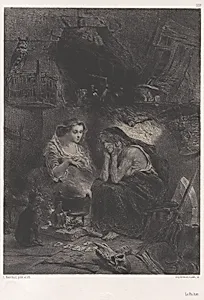
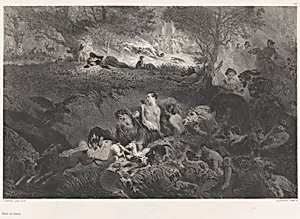
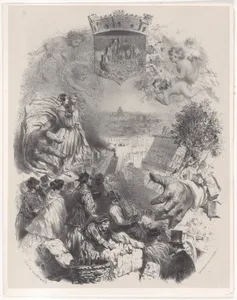
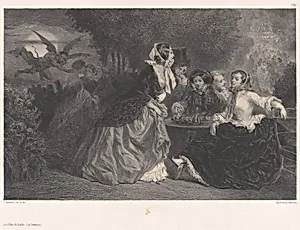
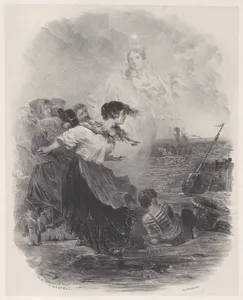
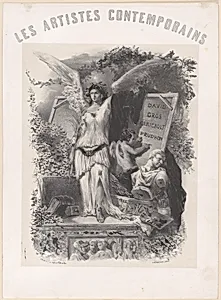
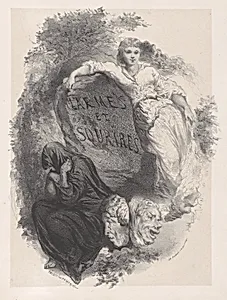
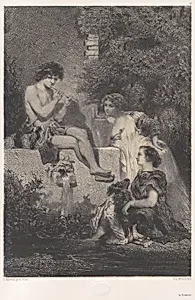
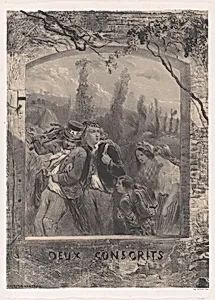
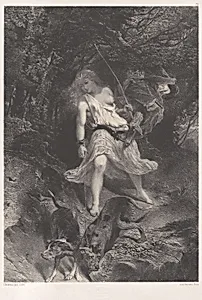
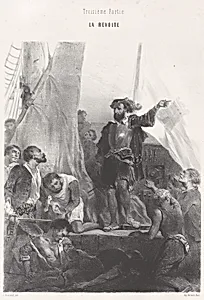
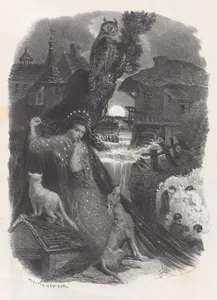
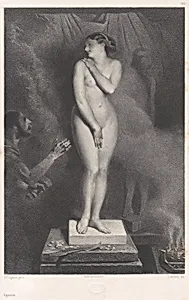
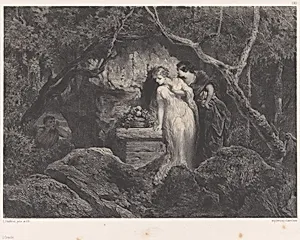
A quintessential figure of French Romanticism, Nanteuil debuted at the Paris Salon in 1833 and exhibited there annually until his death, earning medals in 1837, 1848, 1861, and 1867. Deeply engaged with the Jeunes-France circle, he forged close ties with Victor Hugo, Théophile Gautier, Gérard de Nerval, and Alexandre Dumas, illustrating their works with verve and imagination. His style blended medieval and Renaissance motifs—gnomes, angels, seraphic women, and gothic grotesques—often framed in his innovative "style cathédrale," layering vignettes architecturally around central scenes. Excelling as Romanticism's premier engraver, he pioneered expressive etchings and lithographs, many printed by Bertauts, P. Cadet in Paris, capturing epic, operatic drama for theaters and books.
Nanteuil's oeuvre spans over fifty illustrated volumes, including frontispieces for Hugo's 1832 editions, Gautier's *Albertus* (1832), and Dumas's theater works, alongside lithographs after Delacroix like *François Rabelais* (1836). Notable paintings include *Un rayon de soleil* (1848, Valenciennes), the pendants *Perdition* and *Tentation* (1859, Dijon), and *La Lecture de Don Quichotte* (1873, Dijon). Later, he directed the Académie des Beaux-Arts (1867) and curated Dijon's Musée des Beaux-Arts, receiving the Légion d'honneur in 1868.
Nanteuil died on September 6, 1873, in Bourron-Marlotte, leaving a profound legacy in Romantic printmaking. His inventive illustrations revived gothic fantasy for modern audiences, influencing generations through catalogues raisonnés and retrospectives like the 1973 Dijon exhibition.