
Third Part, The Revolt
ca. 1830–65
Medium
Lithograph
Dimensions
Sheet: 14 1/8 × 10 5/8 in. (35.8 × 27 cm)
Classification
Prints
Department
Drawings and Prints
Museum
Metropolitan Museum of Art, New York, NY
Credit
The Elisha Whittelsey Collection. The Elisha Whittelsey Fund, 1963
Accession Number
63.625.171
Rights
Public Domain
Art Historical Context
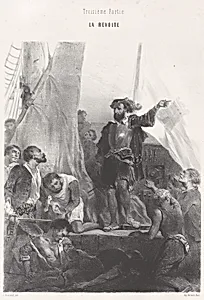
"Third Part, The Revolt" is a captivating lithograph from around 1830–65, created by French artist Célestin Nanteuil (1813–1871) and printed by Bertauts, P. Cadet in Paris. Measuring 14 1/8 × 10 5/8 inches, this print belongs to a series evoking dramatic upheaval, with its title suggesting a narrative progression toward rebellion. Housed in the Metropolitan Museum of Art's Drawings and Prints department as part of The Elisha Whittelsey Collection (acquired 1963), it exemplifies mid-19th-century French graphic art. Lithography, perfected in the early 1800s, allowed artists like Nanteuil—known for his Romantic sensibilities in landscapes, portraits, and illustrations—to produce detailed, tonal images affordably and in multiples. This medium democratized art during a turbulent era of French history, including the July Revolution of 1830 and the 1848 uprisings, when prints often captured revolutionary fervor or social unrest. Nanteuil's precise line work and atmospheric shading likely amplify the scene's intensity, making it a window into the period's political passions. Visitors will appreciate how such works bridged fine art and popular culture, disseminating ideas of revolt amid France's shifting regimes. A testament to lithography's revolutionary potential, this piece invites reflection on art's role in times of change.
About the Artist
Bertauts, P. Cadet, Paris|Célestin Nanteuil (French|French) · |1813 – |1873
|French (born Italy), Rome 1813–1873 Bourron-Marlotte