
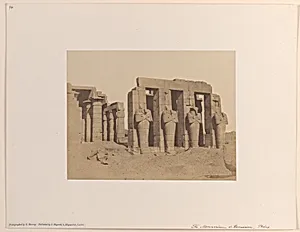
The Memnonium or Rameseiom, Thebes
1852–55, printed 1854–56
Medium
Albumen silver print from waxed paper negative
Dimensions
Image: 6 7/8 in. × 9 in. (17.5 × 22.9 cm) Mount: 12 in. × 15 3/8 in. (30.5 × 39.1 cm)
Classification
Photographs
Department
Photographs
Museum
Metropolitan Museum of Art, New York, NY
Credit
Gift of Charles Isaacs and Carol Nigro, 2015
Accession Number
2015.777.1
Rights
Public Domain
Tags
Art Historical Context
Welcome to the Metropolitan Museum of Art's collection, where *The Memnonium or Reiom, Thebes* (1852–55, printed 1854–56) the majestic ruins of ancient Egypt's Ramesseum, the mortuary temple of Ramesses II in Thebes (modern Luxor Photographed by J. Hogarth and Robert Murray during a pioneering era of travel photography, this image immortalizes colossal stone architecture amid desert sands, showcasing fallen columns and hieroglyph-covered walls that evoke the grandeur of the New Kingdom pharaohs. Created as an albumen silver print from a waxed paper negative—a refined calotype technique popular among 19th-century British photographers—this modest 6 7/8 × 9 in. image represents early efforts to document endangered antiquities. Waxed paper negatives allowed for detailed fieldwork in remote sites, producing rich tonal contrasts that brought distant wonders to European audiences. Amid the Egyptomania sparked by hieroglyph decipherment and archaeological digs, works like this bridged art and science, preserving history before modern excavations altered these ruins forever. A generous gift from Charles Isaacs and Carol Nigro in 2015, this photograph invites us to ponder Ramesses II's legacy while marveling at photography's power to transport us through time.
About the Artist
J. Hogarth|Robert Murray ( |British) · |1822 – |1893
|British, Edinburgh 1822–1893 Plymouth