Ctrl K
**Jean Daullé (1703–1763)** was a prominent French engraver of the eighteenth century, renowned for his reproductive prints after leading painters of the period, including François Boucher. Born on 18 May 1703 in Abbeville to silversmith Jean Daullé and his wife Anne (née Dennel), he began his artistic training at age fourteen under the local engraver Robart at the priory of Saint-Pierre d’Abbeville. He later moved to Paris, where he worked in the studio of fellow Picard engraver Robert Hecquet.
In Paris, Daullé’s talent attracted the attention of the influential print dealer Pierre-Jean Mariette, who provided key recommendations. Shortly afterward, the celebrated portraitist Hyacinthe Rigaud engaged him as his official engraver. Daullé was received into the Académie Royale de Peinture et de Sculpture in 1742 with his reception piece *Hyacinthe Rigaud Painting His Wife*, after Rigaud. He was also admitted to the academy in Augsburg and eventually appointed Engraver to the King. Around 1745 he married Gabrielle-Anne Landry, daughter of engraver and publisher François Landry; the couple had five children.
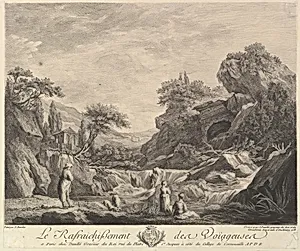
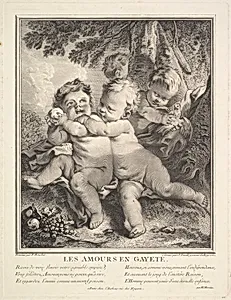
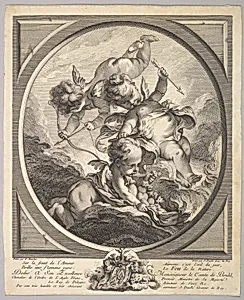
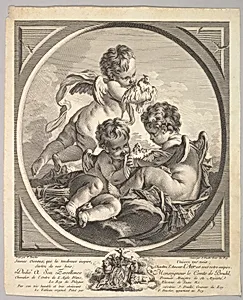
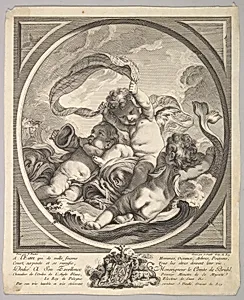
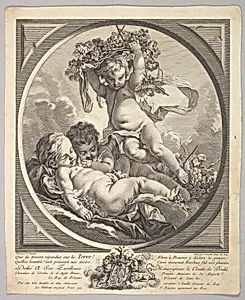
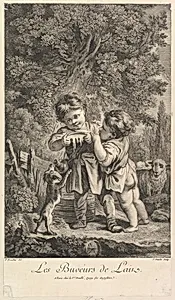
Daullé worked primarily in a clear, firm burin style that placed him among the foremost reproductive engravers of his era. He produced numerous portraits—many after Rigaud—as well as historical, mythological, and genre subjects after masters such as Rembrandt, Rubens, Correggio, and especially François Boucher. Notable examples after Boucher include *The Triumph of Venus* and *Les Amusements de la Campagne*. He also engraved the popular series of the Four Elements (*Air*, *Fire*, etc.) after Boucher’s designs. His output, marked “J.D.,” comprises nearly two hundred plates.
Daullé’s legacy rests on both the quality of his prints and his role as a teacher; he trained the future publisher Pierre-François Basan and the German engraver Jean-Georges Wille. His work helped disseminate the elegant, decorative style of the Rococo period through widely circulated engravings, ensuring the continued appreciation of painters such as Boucher long after their lifetimes. He died in Paris on 23 April 1763.