
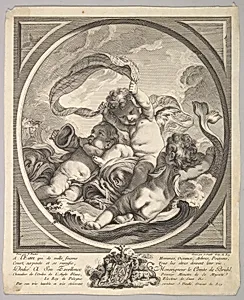
Water
ca. 1748
Medium
Etching and engraving
Dimensions
Sheet: 12 3/4 × 10 1/2 in. (32.4 × 26.7 cm)
Classification
Prints
Department
Drawings and Prints
Museum
Metropolitan Museum of Art, New York, NY
Credit
The Elisha Whittelsey Collection, The Elisha Whittelsey Fund, 1953
Accession Number
56.646.1(4)
Rights
Public Domain
Tags
Art Historical Context
Created around 1748, *Water* is a collaborative etching and engraving by painter François Boucher and printmaker Jean Daullé. Boucher, a leading figure of the French Rococo movement, supplied the original design, which Daullé translated into this refined print. The medium—combining the spontaneity of etching with the precision of engraving—allowed the image to circulate widely, bringing elegant allegorical subjects into private homes and collectors’ portfolios during the Enlightenment. The composition personifies the element of water through graceful figures accompanied by musical instruments, horns, and heraldic motifs, as indicated by the work’s tags. Such imagery reflects the period’s fascination with the four classical elements as symbols of nature’s harmony and human refinement. The coat of arms further suggests a possible commission or dedication, linking the print to aristocratic or institutional patronage. Measuring roughly 12¾ by 10½ inches, this sheet from the Metropolitan Museum’s Elisha Whittelsey Collection exemplifies how reproductive prints extended the reach of Rococo aesthetics beyond the painted canvas, shaping public taste for decorative, lighthearted scenes in mid-eighteenth-century Europe.
About the Artist
Jean Daullé|François Boucher (French|French) · 1703 |1703 –1763 |1770
French, Abbeville 1703–1763 Paris|French, Paris 1703–1770 Paris