
Earth
ca. 1748
Medium
Etching
Dimensions
Sheet (trimmed): 12 5/8 × 10 1/4 in. (32.1 × 26 cm)
Classification
Prints
Department
Drawings and Prints
Museum
Metropolitan Museum of Art, New York, NY
Credit
The Elisha Whittelsey Collection, The Elisha Whittelsey Fund, 1956
Accession Number
56.646.1(3)
Rights
Public Domain
Tags
Art Historical Context
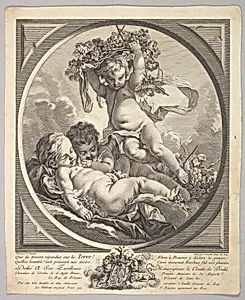
Created around 1748, *Earth* is an etching by engraver Jean Daullé after a design by François Boucher. Measuring just over 12 by 10 inches, this intimate print belongs to a series representing the four elements, a popular allegorical theme in 18th-century France. Daullé’s precise etching technique captures the richness of Boucher’s original composition, translating painterly effects into fine lines and tonal gradations suited to the print medium. Boucher, a leading figure of the Rococo movement, infused such works with graceful figures, lush natural motifs, and a sense of playful elegance. Here, the personification of Earth likely appears amid abundant vegetation and symbolic creatures, reflecting Enlightenment-era fascination with nature’s bounty and order. The presence of a coat of arms suggests the print may have been dedicated to a patron, underscoring the era’s culture of artistic patronage. Today in the Metropolitan Museum’s collection, *Earth* illustrates how reproductive prints helped spread Rococo imagery across Europe, making allegorical themes accessible beyond palace walls.
About the Artist
Jean Daullé|François Boucher (French|French) · 1703 |1703 –1763 |1770
French, Abbeville 1703–1763 Paris|French, Paris 1703–1770 Paris