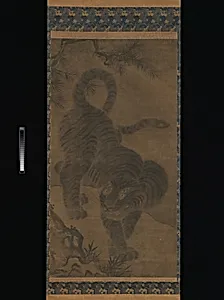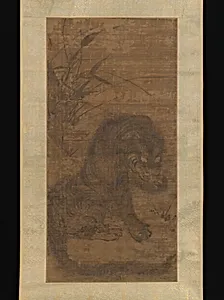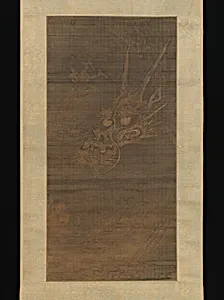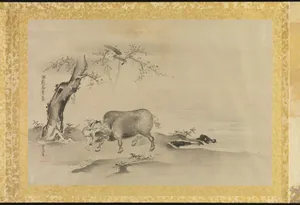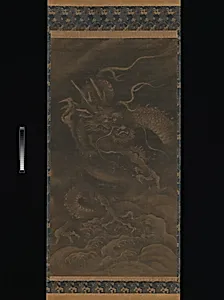
1250–1280
Muqi Fachang (c. 1210?–1269?), a Chan Buddhist monk from Sichuan, emerged as one of the Southern Song dynasty's most evocative painters, blending spiritual insight with bold ink techniques. Early details of his life remain sparse, but he began as a monk in a Sichuan monastery before becoming a disciple of the revered Chan master Wuzhun Shifan (1177–1249) at Mount Qingcheng, where their master-disciple relationship shaped his artistic path. Later, amid political turmoil, Muqi relocated to Hangzhou, the Southern Song capital, associating with the Liu Tong Monastery near West Lake. His possible surname, Li, hints at lay origins, though he fully embraced monastic life.
Muqi worked in the Chan painting tradition, pioneering a "boneless" style— eschewing rigid outlines for fluid, spontaneous ink washes that captured naturalism and instantaneous enlightenment, evoking the essence of Zen philosophy. His masterpieces include the iconic *Six Persimmons* (13th century), a minimalist ink study of fruit embodying Chan ideals of calm transcendence, housed at Daitokuji's Ryoko-in sub-temple in Kyoto. The Daitokuji triptych—*Guanyin, Crane, and Gibbons* (13th century), a National Treasure in Japan—features a white-robed Guanyin amid dynamic wildlife, signed by the "monk from Shu [Sichuan], Fachang." Other verified works encompass *Tiger* and *Dragon* (1250–1279, Cleveland Museum of Art) and sections of *Eight Views of Xiao and Xiang* (c. 1250).
Though overlooked in Song China and critiqued as "coarse" by Yuan scholars for its raw vitality, Muqi's legacy flourished in Japan, where Zen temples treasured his scrolls, influencing Muromachi painters like Mokuan Reien and embedding the "Muqi mode" in ink monochrome traditions. No other Chinese artist rivaled his impact on Kamakura and Nanbokucho painting, bridging Song naturalism to later literati styles and inspiring 20th-century Western Zen fascination. Today, his works invite viewers into a realm where brushstrokes dissolve the boundary between the mundane and the profound.