Ctrl K
**Jan Harmensz. Muller (1571–1628)** was a Dutch engraver, draughtsman, and painter renowned for his masterful reproductive prints after leading Northern Mannerist sculptors and painters, particularly Adriaen de Vries. Born in Amsterdam and baptized on 1 July 1571, Muller came from a family deeply involved in the print trade; his father, Harmen Jansz. Muller, was a book printer, engraver, and publisher. He received his initial training from his father before becoming a pupil of the celebrated engraver Hendrick Goltzius in Haarlem.
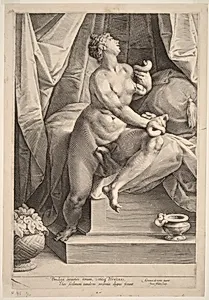
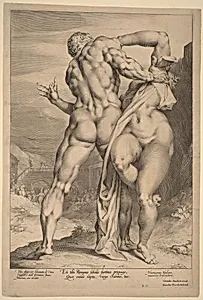
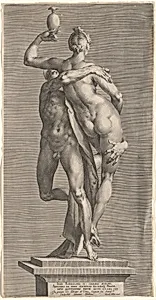
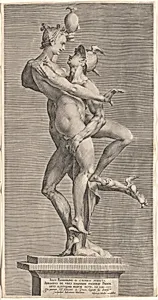
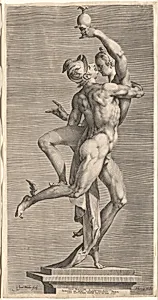
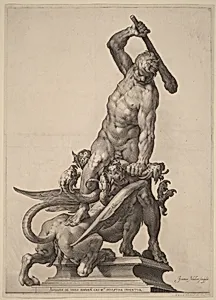
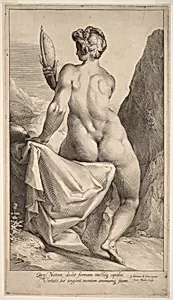
Muller spent much of his career in Amsterdam but traveled extensively between 1594 and 1602, working in Italy and likely Prague, where he connected with the artistic circle around Emperor Rudolf II. During this period, he produced engravings after designs by Bartholomeus Spranger and, most notably, created a series of prints after sculptures by Adriaen de Vries, to whom he was related by marriage. De Vries himself had trained under Giambologna. Muller’s engravings after de Vries, such as the multi-view series of *Mercury and Psyche* (c. 1597) and *Prudence*, are celebrated for their technical brilliance, use of swelling lines, and ability to convey three-dimensional form on the printed page. He also produced original compositions, though reproductive work dominated his output.
Stylistically, Muller worked firmly within the Northern Mannerist tradition, characterized by elegant, elongated figures, intricate detail, and a refined handling of light and shadow in engraving. His prints after de Vries helped disseminate the sculptor’s dynamic, serpentine forms across Europe. Among his documented achievements are at least eleven engravings after de Vries’s works, which remain prized for their interpretive sensitivity and technical innovation.
Muller’s legacy endures through his contributions to the golden age of Dutch printmaking. He ranks among the most imaginative engravers of his generation, bridging the worlds of sculpture and graphic art. His works are held in major collections worldwide, including multiple examples in museum holdings that highlight his pivotal role in preserving and popularizing the achievements of de Vries and his contemporaries.