
Ctrl K
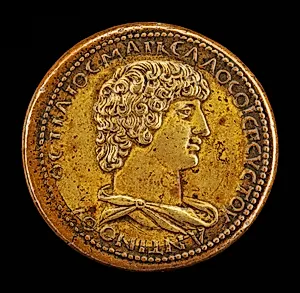
1500–1570
**Giovanni da Cavino: The Paduan Master of Medals and Antiquity**
Giovanni da Cavino, born in May 1500 in Padua to goldsmith Bartolommeo di Giovanni from Cavino d'Arsego, inherited his family's craft from an early age. His father served as his initial master until Bartolommeo's death in 1517, after which Cavino trained in the workshop of the renowned Paduan sculptor Andrea Riccio (1470–1532), who later named him an executor of his will. That same year, Cavino married Romana da Trento, daughter of another goldsmith, and they had two sons: Camillo, a jurist, and Giandomenico, who followed in the family trade. His brother Battista was also a goldsmith. Rooted in Padua's rich traditions of bronze-casting, sculpture, and classical scholarship, Cavino spent his entire career in the city, producing ecclesiastical bronzes and golds like candlesticks for Padua Cathedral (c. 1527–1529, now lost).
Working in the Paduan school tradition, Cavino excelled as a medallist, goldsmith, engraver, and sculptor, crafting over 100 portrait medals of contemporaries and ancient figures with a delicate, incisive style marked by individualized, sensitive portraits, balanced compositions, and graceful reverses drawn from classical motifs. His nervous, linear engravings achieved high relief and crisp details. Yet his enduring fame stems from the "Paduans"—struck bronze imitations of Roman coins, especially sesterces, produced c. 1520–1532 in collaboration with humanist Alessandro Bassiano. These over 100 types, including invented ones like a Julius Caesar bronze, so convincingly replicated ancient aesthetics with Renaissance anatomical precision that they fooled collectors; original dies survive in Paris's Bibliothèque Nationale.
Among his signed masterpieces are the 1538 self-portrait medal with Bassiano; portraits of Girolamo Cornaro (1540), Giovanni Mels, Luca Salvioni, and Cosimo Scapti (National Gallery of Art, Washington); Marco and Giovan Pietro Mantova Benavides; Pope Julius III ("Anglia resurges," 1544); and Charles V, Alfonso d'Avalos, and Gerolamo Fracastoro. He likely crafted a lost bronze tondo for Riccio's monument. Cavino's oeuvre, with some 50 pieces in major collections, blurred forgery and artistry, serving Renaissance demand for antiquities.
Celebrated by Giorgio Vasari as a Paduan glory, Enea Vico, and poet Francesco Savonarola—who dubbed him and Bassiano "fathers" of numismatic art—Cavino was a respected expert, testifying in a 1542 trial. Buried in Padua's San Giovanni di Verdara (tomb later moved), his legacy endures in numismatics and art history, where Paduans evoke classical spirit through masterful modern craft, challenging even experts today.
![Girolamo Cornaro, c. 1486-1551, Venetian Patrician [obverse]](https://images.artheonmuseum.org/nga/thumb/girolamo-cornaro-c-1486-1551-venetian-patrician-nga-45020.webp)
![Cornaro Distributing Alms [reverse]](https://images.artheonmuseum.org/nga/thumb/cornaro-distributing-alms-reverse-nga-45021.webp)
![Temple of Eternity with Goddess [reverse]](https://images.artheonmuseum.org/nga/thumb/temple-of-eternity-with-goddess-reverse-nga-67041.webp)
![Marco Mantova Benavides, 1489-1582, Lawyer and Collector [obverse]](https://images.artheonmuseum.org/nga/thumb/marco-mantova-benavides-1489-1582-lawyer-and-nga-67040.webp)
![Giovanni Antonio Vincenzo Dolce, 1482-1555, Paduan Jurist, Canon of Padua 1516 [obverse]](https://images.artheonmuseum.org/nga/thumb/giovanni-antonio-vincenzo-dolce-1482-1555-paduan-nga-45022.webp)
![Genius Holding a Dolphin and Sacrificing [reverse]](https://images.artheonmuseum.org/nga/thumb/genius-holding-a-dolphin-and-sacrificing-reverse-nga-45023.webp)
![Alessandro Maggi, called Bassiano, and Giovanni da Cavino [obverse]](https://images.artheonmuseum.org/nga/thumb/alessandro-maggi-called-bassiano-and-giovanni-da-nga-45016.webp)
![Genius Holding a Dolphin and Pouring a Libation [reverse]](https://images.artheonmuseum.org/nga/thumb/genius-holding-a-dolphin-and-pouring-a-libation-nga-45017.webp)
![Standing Captive and Africa Mourning [reverse]](https://images.artheonmuseum.org/nga/thumb/standing-captive-and-africa-mourning-reverse-nga-45015.webp)
![Alfonso II d'Avalos, 1502-1546, Marquess of Vasto [obverse]](https://images.artheonmuseum.org/nga/thumb/alfonso-ii-davalos-1502-1546-marquess-of-vasto-nga-45014.webp)
![Luca Salvioni, died 1536, Paduan Jurist [obverse]](https://images.artheonmuseum.org/nga/thumb/luca-salvioni-died-1536-paduan-jurist-obverse-nga-45032.webp)
![Ceres with Book and Cornucopiae [reverse]](https://images.artheonmuseum.org/nga/thumb/ceres-with-book-and-cornucopiae-reverse-nga-45033.webp)
![Mercury Taming Pegasus [reverse]](https://images.artheonmuseum.org/nga/thumb/mercury-taming-pegasus-reverse-nga-45595.webp)
![Girolamo Panico, died 1558, and Pompeo Ludovisi, died 1565 [obverse]](https://images.artheonmuseum.org/nga/thumb/girolamo-panico-died-1558-and-pompeo-ludovisi-nga-45028.webp)
![Balduino del Monte, died 1556, Brother of Pope Julius III, Count of Monte Sansovino 1550 [obverse]](https://images.artheonmuseum.org/nga/thumb/balduino-del-monte-died-1556-brother-of-pope-nga-45026.webp)
![Francesco Querini, died 1563, Venetian Patrician, Poet and Soldier [obverse]](https://images.artheonmuseum.org/nga/thumb/francesco-querini-died-1563-venetian-patrician-nga-45030.webp)
![Giovanni Mels, died 1559, Jurist [obverse]](https://images.artheonmuseum.org/nga/thumb/giovanni-mels-died-1559-jurist-obverse-nga-45024.webp)
![Mels as Genius Holding a Cornucopia and Sacrificing [reverse]](https://images.artheonmuseum.org/nga/thumb/mels-as-genius-holding-a-cornucopia-and-nga-45025.webp)
![Combat between Two Horsemen [reverse]](https://images.artheonmuseum.org/nga/thumb/combat-between-two-horsemen-reverse-nga-45027.webp)
![Genius Holding a Dolphin and Sacrificing [reverse]](https://images.artheonmuseum.org/nga/thumb/genius-holding-a-dolphin-and-sacrificing-reverse-nga-45029.webp)
![She-Wolf with Romulus and Remus [reverse]](https://images.artheonmuseum.org/nga/thumb/she-wolf-with-romulus-and-remus-reverse-nga-45031.webp)
![Cosimo Scapti [obverse]](https://images.artheonmuseum.org/nga/thumb/cosimo-scapti-obverse-nga-45034.webp)
![Homer [obverse]](https://images.artheonmuseum.org/nga/thumb/homer-obverse-nga-45036.webp)