Ctrl K
1626–1688
**Hōzōbō Shinkai (1626–1688)** was a Japanese Buddhist monk and ink painter of the early Edo period, best known for his whimsical depictions of animals—especially cats—infused with poetry and philosophical humor. His name derives from the “monk’s dwelling” (hōzōbō) associated with certain Kyoto Shingon temples linked to the Otokoyama Hachiman Shrine. As a monk-artist, he worked primarily in ink on paper, creating intimate hanging scrolls that blend sensitive brushwork with literary wit.
Shinkai trained in multiple arts that shaped his distinctive style. He studied the tea ceremony under the renowned master Kobori Enshū and is said to have learned calligraphy from Shōkadō Shōjō, one of the leading calligraphers of the time. He also studied haikai poetry with Matsunaga Teitoku, whose influence encouraged Shinkai’s creation of playful kyōka (“madcap verses”). These pursuits informed his approach to sumi-e (ink wash painting), where he used a limited palette of ink tones to convey both serenity and gentle humor, often pairing images with his own verses.
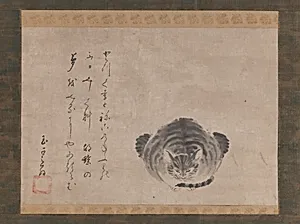
His most celebrated work is the mid-17th-century hanging scroll *Dreaming Cat* (now in the Metropolitan Museum of Art). It portrays a plump, blissfully sleeping tabby cat whose rounded form nearly forms a perfect circle. Accompanying the image is Shinkai’s own kyōka poem that cleverly alludes to the Daoist philosopher Zhuangzi’s famous butterfly dream, transforming the cat into a stand-in for the sage and evoking peonies and butterflies through wordplay. Other known paintings, such as *Meditating Cat with Kyoka Poem*, similarly combine ink imagery with humorous verse, reflecting his love of kyōka.
Though he did not pioneer new movements, Shinkai’s legacy lies in his personal fusion of Buddhist monastic life, tea culture, calligraphy, and lighthearted poetry. His cat paintings remain beloved for their warmth, technical sensitivity, and philosophical playfulness, offering a charming window into early Edo-period artistic and literary circles. The single known work in major public collections underscores his niche but enduring appeal among connoisseurs of Japanese ink painting.