
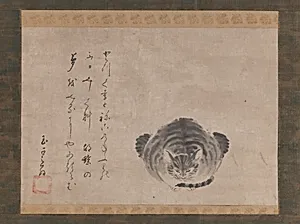
豊蔵坊信海筆 夢中の猫図|Dreaming Cat
mid-17th century
Medium
Hanging scroll; ink on paper
Dimensions
Image: 11 × 16 in. (27.9 × 40.6 cm) Overall with mounting: 44 1/2 × 20 in. (113 × 50.8 cm) Overall with knobs: 44 1/2 × 22 1/2 in. (113 × 57.2 cm)
Classification
Paintings
Culture & Period
Japan · Edo period (1615–1868)
Department
Asian Art
Museum
Metropolitan Museum of Art, New York, NY
Credit
Gift of Sue Cassidy Clark, in honor of John T. Carpenter, 2019
Accession Number
2019.418.3
Rights
Public Domain
Tags
Art Historical Context
Created in mid-17th-century Japan during the peaceful Edo period, *Dreaming Cat* captures a moment of quiet whimsy through the brush of Hōzōbō Shinkai. This delicate hanging scroll, rendered in ink on paper, reflects the era’s appreciation for everyday subjects infused with gentle humor and observation. The compact composition—measuring just 11 by 16 inches—invites close viewing, typical of intimate works meant for private contemplation rather than grand display. Ink painting on paper held deep significance in Japanese art, allowing artists to exploit the medium’s fluidity for expressive, spontaneous effects. Here, Shinkai uses varying tones and minimal strokes to suggest a cat lost in slumber, its relaxed pose conveying both playfulness and serenity. Such animal studies often carried subtle Zen undertones, reminding viewers to find beauty in ordinary moments. Acquired by the Metropolitan Museum of Art in 2019 as a gift honoring curator John T. Carpenter, the scroll exemplifies Edo-period interest in lighthearted yet refined imagery. Its presence in the Asian Art collection offers visitors a charming glimpse into Japan’s rich tradition of animal painting and the enduring appeal of the feline form across centuries.
About the Artist
Hōzōbō Shinkai · 1626–1688
**Hōzōbō Shinkai (1626–1688)** was a Japanese Buddhist monk and ink painter of the early Edo period, best known for his whimsical depictions of animals—especially cats—infused with poetry and philosophical humor. His name derives from the “monk’s dwelling” (hōzōbō) associated with certain Kyoto Shingon temples linked to the Otokoyama Hachiman Shrine. As a monk-artist, he worked primarily in ink on...