
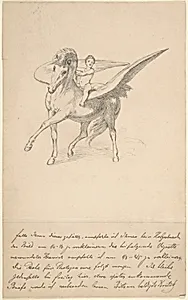
Pegasus and the Young Bellephron
late 19th–early 20th century
Medium
Pen and black ink on buff stock
Dimensions
6 3/8 x 4 in. (16.2 x 10.1 cm)
Classification
Drawings
Department
Drawings and Prints
Museum
Metropolitan Museum of Art, New York, NY
Credit
Gift of Robert L. Isaacson, 1979
Accession Number
1979.674.9
Rights
Public Domain
Tags
Art Historical Context
In the intimate drawing *Pegasus and the Youngphron*, Max K captures a mythical moment from Greek legend with his signature precision. Created in the late 19th to early 20th century, this pen and black ink work on buff stock measures just 6 3/8 x 4 inches, inviting close contemplation. Klinger, a pioneering German Symbolist and etcher, depicts the winged horse Pegasus alongside the youthful hero Bellerophon (often spelled Bellephron in artistic contexts), evoking the boy's legendary quest to tame the divine steed with Athena's golden bridle to battle the Chimera. Klinger's meticulous line work exemplifies his mastery of graphic arts, blending fin-de-siècle fantasy with Jugendstil elegance. Influenced by Romanticism and emerging modernism, he infused mythological subjects with psychological depth, transforming ancient tales into visions of aspiration and the sublime. The buff paper enhances the ink's warm tonality, while the compact scale suggests a personal study, perhaps preparatory for larger prints or sculptures in his fantastical oeuvre. Acquired as a gift to the Metropolitan Museum of Art in 1979, this drawing highlights Klinger's enduring impact on European printmaking. For visitors, it offers a window into how 19th-century artists reimagined classical myths amid rapid cultural change, reminding us of humanity's timeless bond with the divine and heroic.
About the Artist
Max Klinger · 1857–1920
Max Klinger, born on February 18, 1857, in Leipzig to a wealthy family, emerged as one of Germany's most innovative artists across painting, sculpture, printmaking, and graphics. Demonstrating early talent, he enrolled at the Academy of Fine Arts in Karlsruhe in 1874 as a pupil of Karl Gussow, following his teacher to the Berlin Academy upon Gussow's appointment as director, and graduated in 1877 ...