Ctrl K
1700–1899
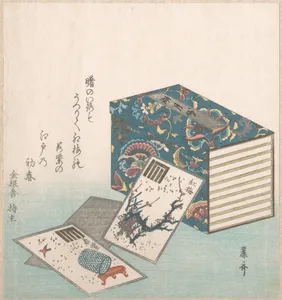
Reisai was a Japanese artist active during the 18th and 19th centuries, best known for his contributions to surimono, the refined privately commissioned woodblock prints often produced for New Year greetings or literary circles. His works typically feature delicate ink and color on paper, incorporating playful or symbolic imagery alongside poetry. The Metropolitan Museum of Art holds examples of his output in this medium, including a print depicting books and cards with intricate, symbolic compositions that highlight his skill in small-scale, high-quality printing.
Details of Reisai’s early life and formal training remain sparsely recorded in available sources. He worked within the broader tradition of Edo-period printmaking, producing limited-edition pieces that blended visual art with literary elements. No specific mentors or art schools are documented in connection with his career, though his style aligns with the elegant, naturalistic tendencies seen in contemporaneous Shijō-school influences.
Among his known works are surimono prints preserved in major collections, with at least three examples associated with institutional holdings. These pieces demonstrate his mastery of polychrome techniques and attention to everyday or auspicious motifs. Reisai’s legacy endures through these surviving prints, which offer insight into the sophisticated private print culture of late Edo and early Meiji Japan.