
Books and Cards
18th–19th century
Medium
Woodblock print (surimono); ink and color on paper
Dimensions
7 x 6 1/2 in. (17.8 x 16.5 cm)
Classification
Prints
Culture
Japan
Department
Asian Art
Museum
Metropolitan Museum of Art, New York, NY
Credit
H. O. Havemeyer Collection, Bequest of Mrs. H. O. Havemeyer, 1929
Accession Number
JP2187
Rights
Public Domain
Tags
Art Historical Context
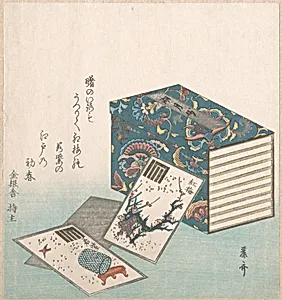
Created in Japan during the late Edo period, "Books and Cards" is a charming surimono—a privately commissioned woodblock print—by the artist Reisai. Measuring just seven by six-and-a-half inches, this intimate work exemplifies the refined aesthetic of surimono, which were typically produced in small editions for poetry circles, New Year greetings, or personal exchanges. Unlike commercial ukiyo-e prints, surimono often featured luxurious details such as embossing and metallic pigments, allowing artists to celebrate everyday objects with poetic elegance. The subject of books and cards reflects the period’s deep appreciation for literature, scholarship, and leisurely pastimes. In a culture where reading and games like karuta were popular among the educated classes, such imagery evoked quiet contemplation and intellectual pleasure. Reisai’s delicate rendering in ink and color on paper transforms these ordinary items into symbols of refined taste. Today housed in the Metropolitan Museum of Art’s Asian Art collection as part of the renowned Havemeyer bequest, this print offers modern viewers a glimpse into the private artistic world of 18th- and 19th-century Japan.
About the Artist
Reisai · 1700–1899
Reisai was a Japanese artist active during the 18th and 19th centuries, best known for his contributions to surimono, the refined privately commissioned woodblock prints often produced for New Year greetings or literary circles. His works typically feature delicate ink and color on paper, incorporating playful or symbolic imagery alongside poetry. The Metropolitan Museum of Art holds examples of h...