Ctrl K
1609–1677
Wang Jian (1609–1677) was a leading Chinese landscape painter of the late Ming and early Qing dynasties, born into a prominent literati family in Taicang, Jiangsu province. As the great-grandson of the distinguished scholar, official, and collector Wang Shizhen, he inherited a rich assemblage of ancient masterpieces that shaped his artistic vision from an early age. After earning the juren degree in 1633, he briefly served in government, including as Prefect of Lianzhou from 1639 to 1641, before retiring to his family estate upon the Ming collapse and refusing service under the Qing. In 1636 he studied painting under the great theorist Dong Qichang, whose ideas on the Southern School and the emulation of ancient masters profoundly influenced him, even though the period of direct instruction was short. He also formed a close friendship with fellow townsman Wang Shimin, who served as a mentor.
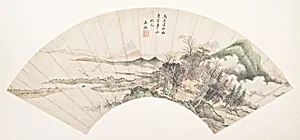
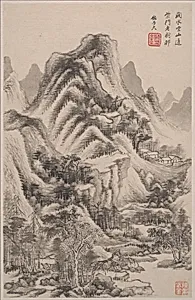
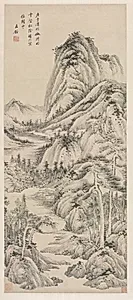
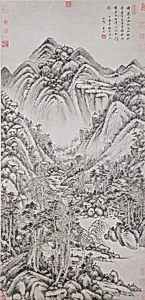
Wang Jian devoted himself to landscape painting in the Orthodox school tradition, ranking among the Four Wangs (alongside Wang Shimin, Wang Hui, and Wang Yuanqi) and the Six Masters of the early Qing. Deeply committed to Dong Qichang’s principles, he derived his style exclusively from Song and Yuan masters such as Dong Yuan, Juran, Huang Gongwang, Wang Meng, Zhao Mengfu, and Wu Zhen, viewing other approaches as unorthodox. He copied and reinterpreted their brushwork and ink techniques with personal sensitivity, often employing restrained color, delicate textures, and poetic compositions that balanced tradition with individual expression. Albums of landscapes in ancient styles became a hallmark of his output, allowing him to scale down and transform canonical models for study and teaching. In 1651 he met the young Wang Hui, who studied under him and later became a celebrated painter in his own right.
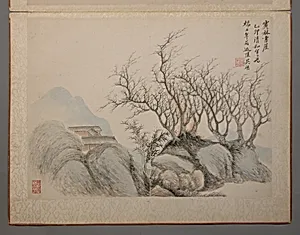
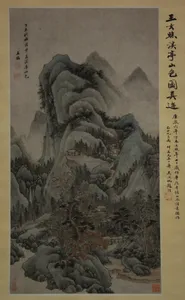
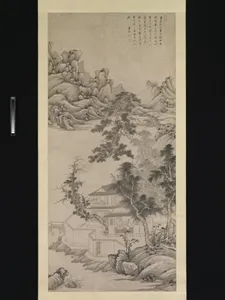
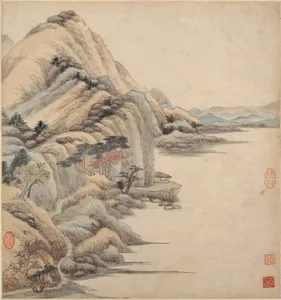
Among his notable works are the ten-leaf album *Miniature Landscapes in Ancient Styles* (1652), a virtuoso display of emulation that captures the spirit of multiple old masters while revealing his own character, and hanging scrolls such as *Landscape after Zhao Mengfu* (1661) and *White Clouds on the Xiao and Xiang Rivers, after Zhao Mengfu* (1668). These pieces, along with others like *Landscape after Wu Zhen* and *Dwelling in the Fuchun Mountains*, demonstrate his painterly skill in combining muscular land masses, misty atmospheres, and elegant brushwork. His inscriptions and theoretical writings further defended the Orthodox lineage against contemporary “decadent” practices. Wang Jian’s legacy as a pillar of the Orthodox school endured through the Qing dynasty, influencing generations of painters and ensuring that the classical traditions of Chinese landscape painting remained vital. His works reside in major collections worldwide, attesting to his enduring place in art history.