
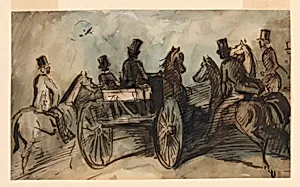
A Carriage and Three Riders
Classification
figures
Department
Smithsonian Collection
Museum
Smithsonian American Art Museum
Credit
Bequest of Erskine Hewitt
Accession Number
1938-57-117
Rights
Public Domain
About this artwork
Research in Progress
Art Historical Context
**A Carriage and Three Riders *Constantin Guys (French, 1802–1892), ca. 1858 Smithsonian American Art Museum, Bequest of Ersk Hewitt Step into the lively streets of mid-19th-century Paris with Constantin Guys' *A Carriage and Three*. Created around 1858, this work captures the dynamic energy of Second Empire France, a time when Baron Haussmann's urban renovations transformed the city into a hub of modernity, fashion, and bustling traffic. Guys, celebrated by poet Charles Baudelaire as the "painter of modern life," specialized in spontaneous sketches of everyday scenes—horses, carriages, and elegant figures dashing through the urban spectacle. Classified among figure studies, the artwork likely showcases Guys' masterful ability to freeze fleeting moments with quick, expressive lines. Though the medium remains unidentified amid ongoing research, his signature style—rapid pen-and-ink drawings or watercolors—evokes the immediacy of real-time observation, predating Impressionism's focus on light and movement. A former war correspondent in the Crimean conflict and illustrator for fashion journals, Guys brought a journalistic eye to high society and street life, making this piece a vivid snapshot of 1850s cosmopolitan thrill. Housed in the Smithsonian American Art Museum through the generous bequest of Erskine Hewitt, *A Carriage and Three Riders* invites us to ponder the rhythm of a bygone era—where a simple ride hinted at adventure and allure. (198 words)