
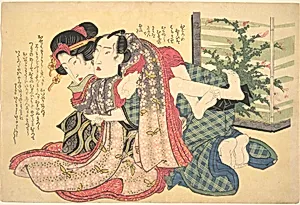
A Couple Locked in an Embrace
ca. 1825
Medium
Woodblock print; ink and color on paper
Dimensions
Horizontal ōban; Image: 10 1/4 × 15 1/8 in. (26 × 38.4 cm)
Classification
Prints
Culture & Period
Japan · Edo period (1615–1868)
Department
Asian Art
Museum
Metropolitan Museum of Art, New York, NY
Credit
Purchase, Arnold Weinstein Gift, 2001
Accession Number
2001.715.14
Rights
Public Domain
Tags
Art Historical Context
This woodblock print by Keisai Eisen, created around 1825 during Japan’s Edo period, captures an intimate moment between a couple surrounded by delicate plants. Eisen, a prominent ukiyo-e artist, was celebrated for his expressive depictions of beautiful women and romantic or erotic scenes. Produced as a horizontal ōban sheet using ink and color on paper, the work exemplifies the vibrant printmaking tradition that flourished in urban centers like Edo (modern Tokyo). In the Edo period, woodblock prints served as affordable art for a growing middle class, blending everyday subjects with refined technique. The horizontal format allowed artists like Eisen to explore dynamic compositions, here emphasizing the tenderness of human connection amid nature. Such images often carried subtle layers of symbolism, with plants evoking themes of growth, transience, or seasonal beauty. Today, this piece in the Metropolitan Museum’s collection offers a window into the playful yet sophisticated visual culture of 19th-century Japan. Its survival highlights the enduring appeal of ukiyo-e as both popular entertainment and refined artistic expression.
About the Artist
Keisai Eisen · 1790–1848
Keisai Eisen (1790–1848), born Ikeda Yoshinobu in Edo (modern Tokyo), emerged as one of the late Edo period's most prolific ukiyo-e masters. The son of the renowned calligrapher and Kanō-school painter Ikeda Shigeharu, Eisen was immersed in the arts from childhood. He apprenticed under Kanō Hakkeisai, adopting the art name "Keisai" in homage to his teacher, and later studied bijin-ga (images of be...