
Erotic Print
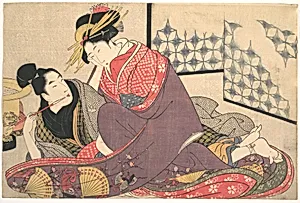
Medium
Woodblock print; ink and color on paper
Dimensions
Image: 10 in. × 15 1/8 in. (25.4 × 38.4 cm) Mat: 15 1/2 × 22 3/4 in. (39.4 × 57.8 cm)
Classification
Prints
Culture & Period
Japan · Edo period (1615–1868)
Department
Asian Art
Museum
Metropolitan Museum of Art, New York, NY
Credit
Anonymous Gift, 1949
Accession Number
JP3165
Rights
Public Domain
Tags
Art Historical Context
Kitagawa Utamaro's *Erotic Print* is captivating example of Edo-period (1615–1868) woodblock printing, a technique that revolutionized Japanese art through its collaborative process of design, carving, and vibrant color application on paper. Created in ink and color, this intimate scene measures 10 × 15⅛ inches and exemplifies *shunga*—erotic prints that were a celebrated genre within the *ukiyo-e* ("pictures of the floating world") tradition. Utamaro, a master of *bijin-ga* (images of beautiful women), brought unparalleled sensitivity to his depictions of the human form, blending sensuality with exquisite detail. During Japan's Edo period, such prints were privately produced and enjoyed by all social classes, reflecting a culture where eroticism intertwined with everyday life and pleasure-seeking urban culture. Utamaro's innovative use of subtle gradients (*bokashi*) and dynamic compositions elevated shunga from mere titillation to high art, influencing later artists like Hokusai and Hiroshige. This anonymous 1949 gift to the Metropolitan Museum of Art offers a window into the playful yet profound world of 18th-century Japanese intimacy. Though the exact date is unknown, the work's tags—highlighting couples, men, and women—underscore its focus on tender, consensual encounters, making it a testament to Utamaro's legacy in capturing beauty and desire.
About the Artist
Kitagawa Utamaro · 1753–1806
Kitagawa Utamaro (c. 1753-1806) was one of the most celebrated masters of ukiyo-e woodblock printing, revolutionizing the art of bijin-ga (pictures of beautiful women) during Japan's Edo period. Born Kitagawa Ichitaro, his early life remains shrouded in mystery, with conflicting accounts placing his birth in Kyoto, Osaka, Yoshiwara in Edo (modern Tokyo), or Kawagoe in Musashi Province. Under the t...