
A Dell, Helmingham Park, Suffolk
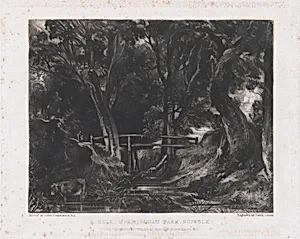
Medium
Mezzotint; second state of five
Dimensions
Image: 5 3/4 × 7 1/4 in. (14.6 × 18.4 cm) Plate: 7 × 8 7/8 in. (17.8 × 22.5 cm) Sheet: 11 1/2 × 17 3/8 in. (29.2 × 44.1 cm)
Classification
Prints
Department
Drawings and Prints
Museum
Metropolitan Museum of Art, New York, NY
Credit
Harris Brisbane Dick Fund, 1943
Accession Number
43.75.12
Rights
Public Domain
Tags
Art Historical Context
Step into the lush Suffolk countryside with *A Dell, Helmingham Park, Suffolk* (1830), a mezzotint print crafted by engraver David Lucas after a painting by John Constable. This second state of five depicts a serene dell—a shaded valley—dotted with grazing cows, dense forests, and a rustic bridge, evoking the idyllic English landscape Constable cherished. Helmingham Park, the historic estate of the Tollemache family, served as inspiration for this intimate study of nature's quiet drama. Mezzotint, a 17th-century technique perfected in the 19th century, allowed Lucas to translate Constable's luminous oil sketches into velvety blacks and subtle tones, mimicking the softness of watercolor or paint. As part of Constable's *English Landscapes* series (published 1830–33), this print highlights their innovative collaboration: Constable supervised the engravings to capture his revolutionary approach to light, atmosphere, and everyday scenery, bridging Romanticism with emerging Realism. Housed in The Metropolitan Museum of Art's Drawings and Prints department (Harris Brisbane Dick Fund, 1943), this work underscores Constable's enduring legacy in celebrating Britain's rural heritage, inviting visitors to savor the tactile beauty of printmaking and the timeless allure of pastoral England.
About the Artist
David Lucas|John Constable · 1802–1881
**David Lucas (1802–1881)** David Lucas was born in 1802 in Geddington Chase, Northamptonshire, the son of a farmer.) A chance encounter in 1820 led him to become a pupil of the renowned engraver Samuel William Reynolds, under whom he apprenticed in London until 1827, mastering the art of mezzotint engraving.) By 1827, Lucas had published his first mezzotints, showcasing his precocious talent for...