
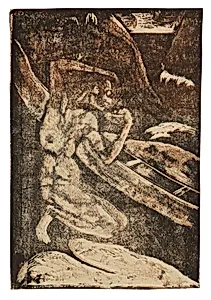
A Fisherman Drinking Beside His Canoe
1894
Medium
Wood-block print, printed twice in brown and black ink, on cream wove Japanese paper laid down on cream wove Japanese paper
Dimensions
Image/primary/secondary support: 20.5 × 13.8 cm (8 1/8 × 5 7/16 in.)
Classification
woodcut
Department
Prints and Drawings
Museum
Art Institute of Chicago
Accession Number
61361
Rights
Public Domain
Art Historical Context
In 1894, Paul Gauguin created *A Fisherman Drinking Beside Canoe*, a striking woodblock print that captures his fascination with Tahitian life during his transformative years in the South Pacific. Having fled the constraints of European society, Gauguin immersed himself Polynesian culture after arriving in Tahiti in 1891. This intimate scene of a fisherman pausing by his canoe embodies his Post-Impressionist vision—bold, flattened forms and symbolic simplicity that reject realistic perspective in favor of emotional and exotic resonance. Printed twice in brown and black inks on cream wove Japanese paper, the work showcases Gauguin's innovative technique. Influenced by Japanese ukiyo-e prints and primitive carving, he carved the blocks himself, layering colors for depth and texture on the delicate support. This labor-intensive process, rare for Western artists at the time, highlights his experimental spirit and quest for authenticity, bridging Eastern print traditions with his Primitivist ideals. Housed in the Art Institute of Chicago's Prints and Drawings Department, this modest 20.5 × 13.8 cm gem reveals Gauguin's pivotal role in modern art, inspiring Fauvism and Expressionism with its raw vitality and cultural fusion. A window into paradise lost, it invites visitors to ponder the artist's search for unspoiled humanity.
About the Artist
Paul Gauguin · 1848–1903
Paul Gauguin (1848-1903) was a French Post-Impressionist painter whose bold experiments with color, form, and subject matter made him one of the most influential figures in the transition from 19th-century art to modernism. His rejection of European civilization for the perceived authenticity of 'primitive' cultures established an archetype of artistic exile that continues to resonate. Gauguin's ...