
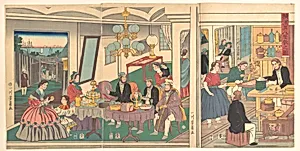
歌川芳員画 「横浜異人屋敷之圖」|A Foreign Residence in Yokohama
Medium
Triptych of woodblock prints (nishiki-e); ink and color on paper
Dimensions
Image: 29 1/2 x 14 3/4 in. (74.9 x 37.5 cm)
Classification
Prints
Culture & Period
Japan · Edo period (1615–1868)
Department
Asian Art
Museum
Metropolitan Museum of Art, New York, NY
Credit
Bequest of William S. Lieberman, 2005
Accession Number
2007.49.159
Rights
Public Domain
Tags
Art Historical Context
**A Foreign Residence in Yokohama**1861) by Utagawa Yoshazu captures a fascinating glimpse into Japan's early encounters with the West. This vibrant triptych woodblock (nishiki-e) depicts the interior of a foreign residence in Yokohama, bustling with men and women engaged in dining and music-making. Instruments, tables laden with food, and Western attire highlight the exotic novelty of these newcomers, reflecting Japanese curiosity during a time of rapid change. Created in the late Edo period (1615–1868), the artwork coincides with Yokohama's emergence as a treaty port after Commodore Perry's arrival in 1854 and the 1859 Harris Treaty. Ukiyo-e artists like Yoshikazu, from the renowned Utagawa school, pioneered the "Yokohama-e" genre, portraying foreigners (異人, *ijin*) in their daily lives. These prints served as both news and entertainment, bridging Japan's centuries-long isolation (*sakoku*) with global influences. The nishiki-e technique—lavish ink and color on paper, achieved through intricate woodblocks—brings the scene to life with rich hues and fine details, folded into a panoramic 29 1/2 x 14 3/4 in. format. Housed in the Metropolitan Museum of Art's Asian Art Department, this bequest piece invites visitors to ponder cultural exchange amid modernization.
About the Artist
Utagawa Yoshikazu · 1845–1870
Utagawa Yoshikazu (active circa 1850–1870) was a Japanese ukiyo-e woodblock print artist who came of age during one of the most dynamic periods in Japanese history — the twilight of the Edo period and the dawning of the Meiji era. Born and active in Edo (present-day Tokyo), he trained under the celebrated master Utagawa Kuniyoshi, one of the towering figures of the Utagawa school renowned for his ...