
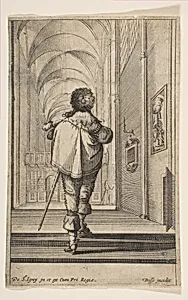
A gentleman seen from behind walking into a church
ca. 1629
Medium
Etching
Dimensions
Sheet (trimmed): 6 1/16 × 3 15/16 in. (15.4 × 10 cm)
Classification
Prints
Department
Drawings and Prints
Museum
Metropolitan Museum of Art, New York, NY
Credit
The Elisha Whittelsey Collection, The Elisha Whittelsey Fund, 1957
Accession Number
57.581.2
Rights
Public Domain
Tags
Art Historical Context
In this intimate etching from around 1629, titled *A Gentleman Seen from Behind Walking into Church*, French artists Abraham Bosse and Jean de Saint-Ig capture a fleeting moment of everyday piety. Viewed from behind, the elegantly dressed gentleman strides toward the grand church entrance, his cloak billowing slightly, evoking the quiet devotion of 17th-century. Measuring just 6 1/16 × 3 15/16 inches, the trimmed sheet invites close inspection, revealing fine architectural details of the church portal. Abraham Bosse, a pioneering etcher active in Paris, was renowned for his meticulous reproductions of contemporary life, costumes, and architecture, often collaborating with figures like Saint-Igny, possibly a publisher or engraver. Etching—a technique using acid to bite lines into a metal plate—allowed Bosse to achieve delicate lines and textures, making prints affordable and widely distributable. This work exemplifies his realistic style, bridging Baroque grandeur with emerging genre scenes, much like those of his mentor Jacques Callot. Housed in the Metropolitan Museum of Art's Elisha Whittelsey Collection, the print offers a window into the cultural centrality of churches in French society, where faith intertwined with social display. Its small scale belies its historical charm, reminding us how art preserved the rhythm of ordinary lives amid Europe's religious upheavals.
About the Artist
Abraham Bosse|Jean de Saint-Igny · 1602–1676
Abraham Bosse (1604–1676) was a French printmaker and theorist whose approximately 1,600 etchings provide an unparalleled visual record of 17th-century French life. Born to Huguenot parents in Tours, he trained in Paris under Melchior Tavernier and became a devoted follower of Jacques Callot's technical innovations. Bosse's meticulous etchings depicted subjects ranging from daily life and fashion ...