
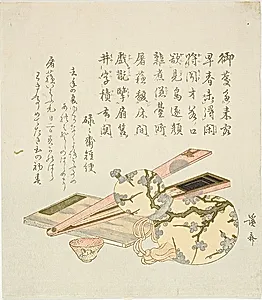
A Gourd Flask, a Cup, a Writing Box, and a Book for Rokurokusai
19th century
Medium
Color woodblock print; surimono
Dimensions
21.8 × 19.2 cm (8 5/8 × 7 9/16 in.)
Classification
woodblock print
Department
Arts of Asia
Museum
Art Institute of Chicago
Accession Number
81270
Rights
Public Domain
Art Historical Context
In the refined world of 19th-century Japanese art, Keisai Eisen's *A Gourd Flask, a, a Writing Box, and a Book for Rokurokusai* stands as a exquisite example of *surimono*—privately commissioned woodblock prints for their superior craftsmanship. Created around the late Edo period (1790–1848, Eisen's active years), this intimate color woodblock print measures 21.8 × 19.2 cm, perfect for personal albums or poetic gatherings. Eisen, a master of the ukiyo-e tradition known for his elegant depictions of beauties and daily life, here captures a still life of everyday scholarly treasures: a curvaceous gourd flask (likely for sake), a delicate cup, an ornate writing box, and an open book, all dedicated to the figure Rokurokusai—possibly a poet or patron in literati circles. *Surimono* like this one elevated woodblock printing beyond mass-produced *ukiyo-e* through luxurious techniques: vibrant mineral colors, subtle embossing (*karazuri*), and sometimes mica or gold flecks for a shimmering effect. These prints were often produced for New Year's or poetry contests (*kyōka*), blending visual artistry with inscribed verses to honor friends or commemorate occasions. Eisen's precise composition and harmonious palette highlight the objects' textures—from the flask's glossy sheen to the box's lacquered elegance—evoking a sense of refined leisure. Housed in the Art Institute of Chicago's Arts of Asia department, this work offers a window into Edo Japan's cultured elite, where art, literature, and subtle symbolism intertwined. Imagine flipping through such a treasured keepsake, savoring its quiet poetry amid the era's fleeting pleasures.
About the Artist
Keisai Eisen · 1790–1848
Keisai Eisen (1790–1848), born Ikeda Yoshinobu in Edo (modern Tokyo), emerged as one of the late Edo period's most prolific ukiyo-e masters. The son of the renowned calligrapher and Kanō-school painter Ikeda Shigeharu, Eisen was immersed in the arts from childhood. He apprenticed under Kanō Hakkeisai, adopting the art name "Keisai" in homage to his teacher, and later studied bijin-ga (images of be...