
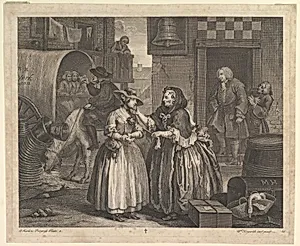
A Harlot's Progress, Plate 1
April 1732
Medium
Etching and engraving; fourth state of four
Dimensions
plate: 12 1/2 x 15 3/8 in. (31.8 x 39.1 cm) sheet: 13 3/8 x 16 in. (33.9 x 40.7 cm)
Classification
Prints
Department
Drawings and Prints
Museum
Metropolitan Museum of Art, New York, NY
Credit
Gift of Sarah Lazarus, 1891
Accession Number
91.1.128
Rights
Public Domain
Tags
Art Historical Context
William Hogarth's *A Harlot's Progress Plate 1*, published in April 1732, launches a groundbreaking series of six satirical prints that trace the tragic downfall of a young country girl in London's underbelly. As an innovative English artist and engraver, Hogarth drew from 18th-century urban life to expose vice, corruption, and social hypocrisy, blending sharp moral commentary with vivid storytelling. This first plate captures the innocent protagonist's arrival in the city—likely amid a bustling scene with horses, men, and women—marking her fateful encounter with temptation. Crafted through etching and engraving in the fourth and final state, the work showcases Hogarth's mastery of intricate line work and tonal depth, allowing for affordable mass production via prints. Measuring about 12½ x 15⅜ inches on the plate, it exemplifies his "modern moral subjects," a novel genre that rivaled paintings in narrative power while critiquing the era's excesses like prostitution and exploitation. Housed in the Metropolitan Museum of Art's Drawings and Prints department (gift of Sarah Lazarus, 1891), this print remains a cultural touchstone, influencing later satirical art from Swift to modern graphic novels. Hogarth's unflinching gaze invites viewers to reflect on timeless human frailties.
About the Artist
William Hogarth · 1697–1764
William Hogarth (1697-1764) was an English painter, printmaker, and pictorial satirist who became the first great English-born artist to attract admiration abroad. Born into poverty in London, the son of a failed schoolmaster who was imprisoned for debt, Hogarth's early experiences with the harsh realities of 18th-century urban life profoundly shaped his artistic vision. After apprenticing with si...