
A Rake's Progress, Plate 5
June 25, 1735
Medium
Engraving; first state of three
Dimensions
sheet: 13 7/8 x 15 3/4 in. (35.3 x 40 cm)
Classification
Prints
Department
Drawings and Prints
Museum
Metropolitan Museum of Art, New York, NY
Credit
Harris Brisbane Dick Fund, 1932
Accession Number
32.35(32)
Rights
Public Domain
Tags
Art Historical Context
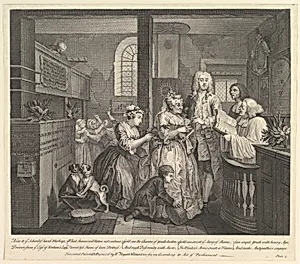
**A Rake's Progress Plate 5** is a masterful engraving from William Hogarth's iconic 1735 moralistic series, *A Rake's Progress Created in collaboration with Dr. John Hoadley, who contributed verses, this first-state proof captures Plate 5's satirical scene amid the young rake Tom Rakewell's descent ruin. Dated June 25, 1735, the work measures 13 7/8 x 15 3/4 inches and exemplifies Hogarth's narrative genius, blending sharp social commentary with vivid storytelling in the English satirical tradition. In this bustling composition, Hogarth depicts a motley crowd of men, women, children, and dogs witnessing Tom's forced marriage to a wealthy but grotesque older woman—a desperate bid for fortune that seals his doom. The engraving's intricate details, from leering faces to symbolic props, highlight the hypocrisies of 18th-century London society, critiquing greed, vice, and fleeting pleasures. As a print from the Drawings and Prints department at The Metropolitan Museum of Art (acquired via the Harris Brisbane Dick Fund in 1932), it reflects the era's booming print culture, making high art accessible to the masses. Hogarth's technique—bold lines, exaggerated features, and layered symbolism—elevates engraving beyond mere reproduction, influencing later caricature artists like Rowlandson. This plate invites visitors to ponder timeless warnings: how ambition unchecked leads to folly, all delivered with Hogarth's wicked wit.
About the Artist
William Hogarth|Dr. John Hoadley · 1697–1764
William Hogarth (1697-1764) was an English painter, printmaker, and pictorial satirist who became the first great English-born artist to attract admiration abroad. Born into poverty in London, the son of a failed schoolmaster who was imprisoned for debt, Hogarth's early experiences with the harsh realities of 18th-century urban life profoundly shaped his artistic vision. After apprenticing with si...