
A Letter to Eugène Maus, Decorated with Two Apples
August 2, 1880
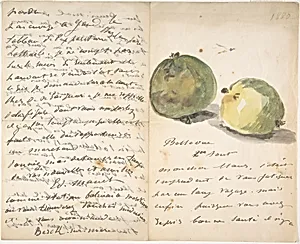
Medium
Watercolor, pen and ink on wove paper
Dimensions
sheet: 7 15/16 x 9 3/4 in. (20.1 x 24.8 cm); folded once to form four pages
Classification
Drawings
Department
Drawings and Prints
Museum
Metropolitan Museum of Art, New York, NY
Credit
Purchase, Guy Wildenstein Gift, 2003
Accession Number
2003.1
Rights
Public Domain
Tags
Art Historical Context
Step into the intimate world of Édouard Manet with *A Letter to Eugène, Decorated with Two* (August 2, 1880), a charming watercolor and pen-and-ink gem on wove paper, now folded into four delicate pages at the Metropolitan Museum of Art Measuring just 7 15/16 x 9 3/4 inches, this from the Drawings and Prints department reveals the French master's playful side beyond his bold canvases. Manet, a trailblazer bridging Realism and Impressionism, sent this personal correspondence to Eugène Henri Maus, a Belgian art critic and promoter of avant-garde circles. What makes this piece special is its fusion of epistolary art and still life—two vibrant apples adorn the letter, echoing Manet's fascination with everyday motifs like fruit, as seen in his iconic paintings. The loose, expressive watercolor strokes and precise ink lines showcase his virtuoso draftsmanship, techniques honed in an era when artists increasingly blurred lines between fine art and personal expression. Created late in Manet's career, just three years before his death, it humanizes the artist, turning a mundane note into a decorative treasure. Acquired through the Guy Wildenstein Gift in 2003, this rare survival invites us to ponder how correspondence became a canvas for creativity in 19th-century Paris. A delightful glimpse into artistic camaraderie and innovation!
About the Artist
Edouard Manet|Eugène Henri Maus · 1832–1883
Édouard Manet (1832-1883) was a French painter who played a pivotal role in the transition from Realism to Impressionism, often called the 'Father of Modern Art.' Born into a wealthy Parisian family, Manet defied his father's wishes for a legal career to pursue painting, studying under academic artist Thomas Couture. His revolutionary works 'Le Déjeuner sur l'herbe' and 'Olympia' (both 1863) scand...