
Program for the Evening of April 11, 1891
Medium
pen and ink, watercolor on wove paper
Dimensions
sheet: 9 5/8 x 6 5/16 in. (24.5 x 16 cm)
Classification
Drawings
Department
Drawings and Prints
Museum
Metropolitan Museum of Art, New York, NY
Credit
Gift of Bella C. Landauer, 1950
Accession Number
50.511.7
Rights
Public Domain
Tags
Art Historical Context
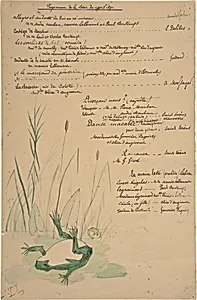
This charming anonymous French drawing, titled *Program for the Evening of 11, 1891*, captures the whimsical spirit of late 19th-century Parisian social life. Created with pen and ink and watercolor wove paper, it likely served as an illustrated handout for a theatrical or musical evening event. The delicate motifs of frogs and leaves—evident from its tags—suggest a playful, nature-inspired design, perhaps evoking the frolicsome cabaret culture or seasonal festivities popular in Belle Époque France. Measuring just 9⅝ × 6¼ inches, its intimate scale made it perfect for pocket-sized distribution among theatergoers. The use of pen and ink for precise line work combined with watercolor's soft washes highlights the technical finesse of French graphic arts during this era. Wove paper, smooth and versatile, was a staple for such ephemera, allowing vibrant yet refined color application. As a drawing in the Metropolitan Museum of Art's Prints and Drawings department—gifted by Bella C. Landauer in 1950—this piece preserves a fleeting moment of cultural entertainment, offering insight into everyday artistry beyond grand masterpieces. Though the specific event remains a mystery, its survival underscores the value museums place on vernacular graphics, reminding us how frogs and foliage could delight audiences over a century ago. A delightful glimpse into 1891's lighter side!
About the Artist
Anonymous, French, 19th century · 1800–1900
**Anonymous, French, 19th Century (ca. 1800–1900)** The artist cataloged as Anonymous, French, 19th century embodies the enigmatic yet essential contributions of unidentified creators to France's vibrant 19th-century art world. Active roughly between 1800 and 1900, this figure—or potentially collective workshop—produced a diverse array of works amid the nation's transition from Neoclassicism thro...