
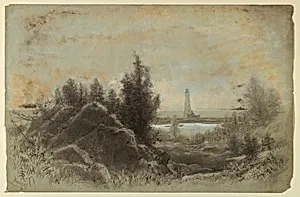
A Lighthouse
November 27, 1877
Classification
landscapes
Department
Smithsonian Collection
Museum
Smithsonian American Art Museum
Credit
Gift of Mrs. F. Hopkinson Smith
Accession Number
1923-41-5
Rights
Public Domain
About this artwork
Research in Progress
Art Historical Context
Francis Hopkinson Smith (183–1915) was a versatile American artist, author, and engineer whose multifaceted career captured the spirit of 19th-century America. known for his luminous watercolor landscapes, particularly coastal scenes from Maine and Long Island, often depicted maritime subjects like lighthouses, which symbolized guidance and resilience amid the nation's expanding seafaring heritage. Painted on November 27,1877—during the post-Civil War Gilded, when lighthouses dotted America's rugged shores to aid booming trade—"A Lighthouse" reflects this era's fascination with natural drama and human ingenuity. Classified as a landscape in the Smithsonian American Art Museum's collection, this work likely showcases Smith's skill in rendering atmospheric light and texture, hallmarks of his tonalist-influenced style. Though the medium remains unidentified amid ongoing research, his pieces typically evoke the moody interplay of sea, sky, and stone, inviting viewers to ponder the solitary sentinel's role in safeguarding lives. Donated by his wife, Mrs. F. Hopkinson Smith, it preserves a personal legacy within the Smithsonian's holdings. Step into this evocative scene and imagine the fog-shrouded beacon standing firm against Atlantic gales—a testament to America's maritime soul.