
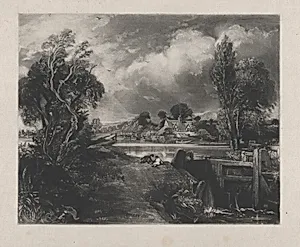
A Lock on the Stour
Medium
Mezzotint on chine collé; proof before published state
Dimensions
Image: 5 11/16 × 7 1/16 in. (14.4 × 17.9 cm) Plate: 7 × 8 7/16 in. (17.8 × 21.4 cm) Sheet: 9 9/16 × 12 1/4 in. (24.3 × 31.1 cm)
Classification
Prints
Department
Drawings and Prints
Museum
Metropolitan Museum of Art, New York, NY
Credit
Harris Brisbane Dick Fund, 1927
Accession Number
27.4.16
Rights
Public Domain
Tags
Art Historical Context
**A Lock on the St** is a captivating mezzotint print created in 1830 by engraver David Lucas after a composition by the renowned English Romantic painter John Constable. It depicts a serene landscape along the River Stour in Suffolk, a waterway central to Constable's childhood and artistic inspiration. The scene features a lock with human figures, lush trees, and the gently flowing river—hallmarks of Constable's love for the natural beauty of Dedham Vale, rendered with his signature attention to atmospheric light and everyday rural life. This proof before the published state, on chine collé (a delicate Chinese paper adhered to a stronger support), showcases mezzotint's velvety tonal range, ideal for capturing Constable's luminous skies and textured foliage. Lucas's collaboration with Constable produced the ambitious *English Landscape Scenery* series, making the artist's oil sketches accessible through prints during the 1830s. As a rare early impression, it highlights the meticulous printing process before final lettering. Housed in The Metropolitan Museum of Art's Drawings and Prints department (acquired via the Harris Brisbane Dick Fund in 1927), this work bridges painting and printmaking, democratizing Constable's Romantic vision of Britain's countryside for a wider audience. A testament to 19th-century innovation in reproductive art, it invites visitors to ponder the harmony between human activity and nature.
About the Artist
David Lucas|John Constable · 1802–1881
**David Lucas (1802–1881)** David Lucas was born in 1802 in Geddington Chase, Northamptonshire, the son of a farmer.) A chance encounter in 1820 led him to become a pupil of the renowned engraver Samuel William Reynolds, under whom he apprenticed in London until 1827, mastering the art of mezzotint engraving.) By 1827, Lucas had published his first mezzotints, showcasing his precocious talent for...