
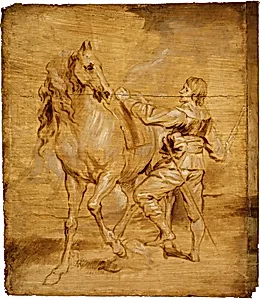
A Man Mounting a Horse
ca. 1630
Medium
Oil on wood
Dimensions
10 x 8 3/4 in. (25.4 x 22.2 cm)
Classification
Paintings
Department
European Paintings
Museum
Metropolitan Museum of Art, New York, NY
Credit
Gift of Mr. and Mrs. Siegfried Bieber, 1949
Accession Number
49.145.2
Rights
Public Domain
Tags
Art Historical Context
Anthony van Dyck's *A Man Mounting a Horse (ca. 1630) is a captivating oil sketch on wood, measuring just 10 x 8 3/4 inches, now housed in the Metropolitan Museum of Art European Paintings department. Created during the artist's time in Italy, where he honed his portraiture amid the Genoese nobility, this intimate study exemplifies Flemish Baroque dynamism. Van Dyck, a protégé of Peter Paul Rubens, masterfully captured the fluid motion of a rider swinging onto his steed, blending realism with elegant poise. The small scale and oil medium suggest this was likely a preparatory *bozzetto*—a quick, luminous sketch for a larger composition—highlighting Van Dyck's virtuoso technique. Loose brushwork conveys energy and anatomy, with dramatic light modeling the figures' forms against a minimal background. Horses and equestrian themes recur in his oeuvre, symbolizing power and nobility, reflecting the era's aristocratic ideals. This gifted work from 1949 offers a window into Van Dyck's process, whose style profoundly influenced European portraiture, especially at the English court of Charles I. A perfect gem for savoring Baroque grace up close!
About the Artist
Anthony van Dyck · 1599–1641
Sir Anthony van Dyck (1599-1641) was a Flemish Baroque artist who revolutionized portrait painting and became the most influential court painter in 17th-century England. Born in Antwerp as the seventh of twelve children to a prosperous silk merchant, van Dyck displayed extraordinary artistic talent from childhood. He trained under Hendrick van Balen before joining Peter Paul Rubens's workshop as a...