
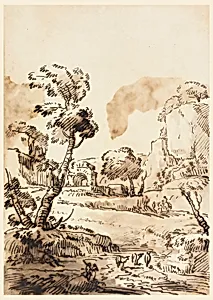
A Pastoral Landscape
1760–1780
Classification
landscapes
Department
Smithsonian Collection
Museum
Smithsonian American Art Museum
Credit
Museum purchase through gift of various donors
Accession Number
1901-39-357
Rights
Public Domain
About this artwork
Research in Progress
Art Historical Context
**A Pastoral Landscape** by Carlo Marchionni (2–1786), an esteemed Italian architect and artist active in Rome during the Late Baroque and early Neoclassical periods, dates to around 1760–1780. This evocative work captures the timeless allure of rural idylls, a favored theme in 18th-century European art that romanticized nature as an escape from urban life. Marchionni, known for his architectural designs like the Trevi Fountain's façade and the church of Sant'Ignazio, brought a refined sensibility to landscapes, blending precise observation with harmonious compositions that echo the era's shift from ornate Rococo flourishes to more balanced, classical ideals. Pastoral scenes like this one drew inspiration from ancient poets like Virgil, evoking Arcadia—a mythical paradise of shepherds and serene meadows. Though the medium remains under study (research in progress), such works often employed oil on canvas or detailed drawings to convey luminous skies, rolling hills, and rustic figures, inviting viewers to ponder humanity's harmony with the land. Acquired through museum purchase with gifts from various donors, it graces the Smithsonian American Art Museum's collection, highlighting transatlantic exchanges of artistic traditions. This piece offers a window into Enlightenment-era reveries, reminding us how landscapes transcended borders to inspire tranquility and reflection. Visit to immerse yourself in its gentle beauty! (198 words)