
A Path Through the Woods
17th century
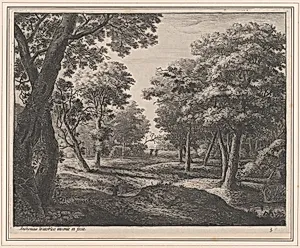
Medium
Etching; third state of three
Dimensions
sheet: 9 3/16 x 11 9/16 in. (23.3 x 29.4 cm)
Classification
Prints
Department
Drawings and Prints
Museum
Metropolitan Museum of Art, New York, NY
Credit
Harris Brisbane Dick Fund, 1947
Accession Number
47.100.33
Rights
Public Domain
Tags
Art Historical Context
Step into the serene world of 17th-century Dutch landscape art with *A Path Through the Woods*, exquisite etching by Anthonie Waterloo Created during the Dutch Golden Age, when artists mastered capturing nature's quiet poetry, this print exemplifies Waterloo's reputation for intricate, atmospheric landscapes. The third state of three indicates the final, refined version of the plate, where the artist likely enhanced details for maximum depth and texture. Etching a revolutionary intaglio technique in the Baroque era, Waterloo to incise fine lines into a metal plate with acid, producing rich, velvety blacks and subtle tones on paper. Measuring 9 3/16 x 11 9/16 inches, this sheet invites viewers along a winding road flanked by towering trees, evoking a sense of peaceful exploration amid dense foliage. Such motifs celebrated the Dutch fascination with the natural world, blending realism with poetic introspection. Acquired through the Harris Brisbane Dick Fund in 1947 and housed in the Metropolitan Museum of Art's Drawings and Prints department, this work highlights the enduring appeal of printmaking as an accessible art form. Waterloo's mastery turns a simple forest path into a meditative journey, reminding us of nature's timeless allure.
About the Artist
Anthonie Waterloo · 1609–1690
Anthonie Waterloo (1609–1690) was a prominent Dutch Golden Age landscape artist, born on May 6 in Lille, then part of the Spanish Netherlands. Little is known of his early life beyond his mother, Magdalena Vaillant, who joined Amsterdam's Walloon Church in 1621, with Waterloo following in 1630; no records exist of formal training, and he was likely self-taught. Registered as a painter in Amsterdam...