
Shepherd Asleep on a Hummock
17th century
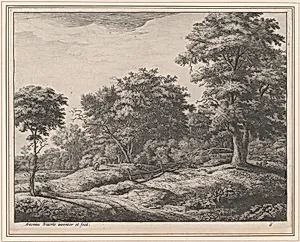
Medium
Etching; second state of three
Dimensions
sheet: 9 1/4 x 11 3/4 in. (23.5 x 29.8 cm)
Classification
Prints
Department
Drawings and Prints
Museum
Metropolitan Museum of Art, New York, NY
Credit
Harris Brisbane Dick Fund, 1947
Accession Number
47.100.21
Rights
Public Domain
Tags
Art Historical Context
In the tranquil etching *Shepherd Asleep on Hummock*, 17th-century Dutch artistthonie Waterloo captures a pastoral moment. Created during the Dutch Golden Age, when landscape prints flourished, this work exemplifies Waterloo's mastery of intricate natural scenes. As a specialist in wooded landscapes and atmospheric etchings, he draws viewers into a quiet countryside idyll, evoking the era's fascination with rural harmony amid urban prosperity. The composition centers on a shepherd dozing peacefully atop a grassy hummock, surrounded by grazing sheep and stately trees. Rendered in the second state of three—a progressive refinement in printmaking—this etching showcases Waterloo's precise line work, where acid-bitten copper plates allow for delicate textures in foliage and fur. Measuring 9¼ x 11¾ inches, its intimate scale invites close inspection of subtle tonal shifts that convey depth and soft light. Housed in the Metropolitan Museum of Art's Drawings and Prints department (Harris Brisbane Dick Fund, 1947), this print highlights etching's role in democratizing art, making high-quality images accessible beyond paintings. Waterloo's evocative depiction of restful shepherds celebrates timeless themes of nature's gentle embrace, offering museum visitors a peaceful escape into 17th-century reverie.
About the Artist
Anthonie Waterloo · 1609–1690
Anthonie Waterloo (1609–1690) was a prominent Dutch Golden Age landscape artist, born on May 6 in Lille, then part of the Spanish Netherlands. Little is known of his early life beyond his mother, Magdalena Vaillant, who joined Amsterdam's Walloon Church in 1621, with Waterloo following in 1630; no records exist of formal training, and he was likely self-taught. Registered as a painter in Amsterdam...