
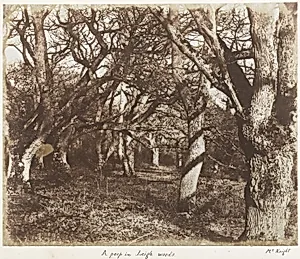
A Peep in Leigh Woods
1853–56
Medium
Salted paper print
Dimensions
Image: 18.1 × 22 cm (7 1/8 × 8 11/16 in.)
Classification
Photographs
Department
Photographs
Museum
Metropolitan Museum of Art, New York, NY
Credit
Gilman Collection, Gift of The Howard Gilman Foundation, 2005
Accession Number
2005.100.382 (20)
Rights
Public Domain
Tags
Art Historical Context
James Knight’s *A Peep in Leigh Woods* (1853–56) offers a quiet glimpse into the early years of photography. Created as a salted paper print—a pioneering technique invented by William Henry Fox Talbot—this small image measures just 18.1 by 22 centimeters. The soft, matte surface typical of the process lends the forest scene a gentle, almost painterly quality, inviting viewers to linger over the play of light filtering through the trees. In the 1850s, photography was still establishing itself as both a scientific marvel and an artistic medium. Knight’s choice of a wooded landscape reflects the period’s growing fascination with nature as a subject worthy of careful observation. Salted paper prints, made by coating paper with silver salts, allowed photographers to capture intricate details while producing subtle tonal gradations that feel intimate rather than clinical. Acquired by the Metropolitan Museum of Art through the Gilman Collection in 2005, the work stands as a modest yet eloquent example of how early photographers transformed everyday scenes into enduring visual poetry. Its forest setting continues to evoke the timeless appeal of seeking refuge in nature.
About the Artist
James Knight
James Knight was a British artist active during the mid-nineteenth century, best known for his work as a photographer producing salted paper prints. His identity remains somewhat elusive in historical records, though he is documented as working in Britain during the 1850s and 1860s. No details of his early life, formal training, or artistic mentors have been identified in available sources. Knigh...