
A relaxed face (left); Profound attention (right)
1854-1856, printed 1862
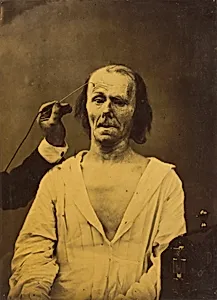
Medium
albumen print
Dimensions
image: 22.3 × 16.2 cm (8 3/4 × 6 3/8 in.) mount: 40.3 × 27.4 cm (15 7/8 × 10 13/16 in.)
Classification
Photograph
Department
CPH
Museum
National Gallery of Art, Washington, D.C.
Credit
Eugene L. and Marie-Louise Garbáty Fund
Accession Number
2015.52.17
Rights
Public Domain
Art Historical Context
In the mid-19th century, neurologist Guillaume-Benjamin-Amand Duchenne de Boulog revolutionized the study of human emotion through pioneering photographic experiments. *A relaxed face (left Profound attention (right)*, created between 1854 and 1856 and printed an albumen silver print in 1862, captures two starkly contrasting expressions on a single subject. Using faradic electricity to stimulate facial muscles, Duchenne documented authentic, involuntary responses, free from conscious posing—a breakthrough in both science and visual documentation. This albumen print, prized for its sharp detail and rich tonal gradations achieved through egg-white emulsion on paper, exemplifies early photography's marriage with medical research. Featured in Duchenne's seminal 1862 album *Mécanisme de la physionomie humaine*, the images influenced thinkers like Charles Darwin, who cited them in *The Expression of the Emotions in Man and Animals*. At 22.3 × 16.2 cm, the intimate scale draws viewers into the subtle play of muscles, revealing the anatomy of feeling. Today, housed in the National Gallery of Art thanks to the Eugene L. and Marie-Louise Garbáty Fund, this work bridges art and science, highlighting photography's power to freeze fleeting human truths and foreshadowing modern psychology and cinema's exploration of expression.
About the Artist
Guillaume-Benjamin-Amant Duchenne (de Boulogne)
Guillaume-Benjamin-Amant Duchenne de Boulogne (1806–1875) was a French neurologist whose pioneering use of photography to document human facial expression placed him at the unique intersection of medical science and visual art. Though primarily a physician rather than an artist in the conventional sense, his photographic work — produced in the 1850s and 1860s — has been recognized as a significant...