
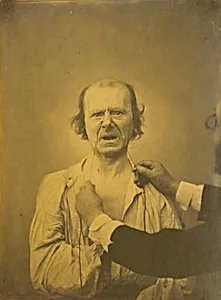
Discontent, bad humor
1854-1856, printed 1862
Medium
albumen print
Dimensions
image: 22.7 × 16.7 cm (8 15/16 × 6 9/16 in.) mount: 43 × 27.9 cm (16 15/16 × 11 in.)
Classification
Photograph
Department
CPH
Museum
National Gallery of Art, Washington, D.C.
Credit
Edward E. MacCrone Fund
Accession Number
2015.52.32
Rights
Public Domain
Art Historical Context
Guillaume-Benjamin-A Duchenne de Boulogne, a pioneering French neurologist and photographer, capturedDiscontent, Bad Humor* between 1854 and 1856, printing it as an albumen print in 1862. This evocative image is part of his groundbreaking series *Mécanisme de laionomie humaine* ( of Human Facial Expression), he used low-level electrical stimulation to provoke authentic emotional responses on subjects' faces. Working at a time when photography was still novel, Duchenne bridged medicine and visual art, documenting over 70 expressions to scientifically analyze human emotion—ideas that later influenced Charles Darwin's *The Expression of the Emotions in Man and Animals* (1872). The albumen print medium, made by coating paper with egg whites and silver salts, yields the rich tonal gradations and fine detail seen here (image: 22.7 × 16.7 cm), mounted larger for display (43 × 27.9 cm). This technique, dominant in the 1850s-60s, allowed unprecedented realism in capturing subtle facial nuances, elevating photography from mere documentation to a tool for psychological insight. Today, in the National Gallery of Art's collection (Edward E. MacCrone Fund, CPH Department), this work highlights 19th-century innovations at the science-art nexus, reminding us how a grimace can reveal the universal language of feeling.
About the Artist
Guillaume-Benjamin-Amant Duchenne (de Boulogne)
Guillaume-Benjamin-Amant Duchenne de Boulogne (1806–1875) was a French neurologist whose pioneering use of photography to document human facial expression placed him at the unique intersection of medical science and visual art. Though primarily a physician rather than an artist in the conventional sense, his photographic work — produced in the 1850s and 1860s — has been recognized as a significant...