
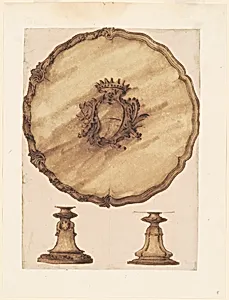
A Salver and an Openwork Base
1755/1760
Medium
pen and brown ink with brown wash over black chalk and graphite on laid paper, laid down on an album sheet
Dimensions
sheet: 35.6 × 25.7 cm (14 × 10 1/8 in.) mount: 45.6 × 33.6 cm (17 15/16 × 13 1/4 in.)
Classification
Drawing
Department
CG-E
Museum
National Gallery of Art, Washington, D.C.
Credit
William B. O'Neal Fund
Accession Number
2016.68.2
Rights
Public Domain
Art Historical Context
Luigi Valadier’s drawing *A Salver and an Openwork Base* captures the refined elegance of mid-eighteenth-century decorative design. Created between 1755 and 1760, the sheet presents a detailed study for a silver tray and its pierced stand, rendered with pen and brown ink over preparatory chalk and graphite. Valadier, a leading Roman silversmith, used delicate washes to suggest the play of light across raised surfaces and openwork patterns, revealing how such objects would catch candlelight in aristocratic dining rooms. The medium itself highlights the careful planning behind luxury metalwork. By laying the paper on an album sheet, the artist preserved a working design that could be shared with patrons or workshop assistants. The precise linework and subtle shading demonstrate the transition from drawing to finished object, offering viewers a rare glimpse into the creative process of one of Europe’s most celebrated silversmiths. Today, this drawing stands as both an artwork and a document of taste during the waning years of the rococo style. Its measured proportions and ornamental motifs reflect the period’s growing preference for clarity and symmetry, qualities that would soon define neoclassicism.
About the Artist
Luigi Valadier · 1726–1785
**Luigi Valadier (1726–1785)** was a leading Italian goldsmith, silversmith, jeweler, and sculptor active in eighteenth-century Rome. Born in Rome on February 26, 1726, he was the son of Andrea Valadier, a French-born silversmith who had settled in the city in 1714 and established a successful workshop on via del Babuino. Luigi trained and began his career in his father’s workshop, assuming its di...