
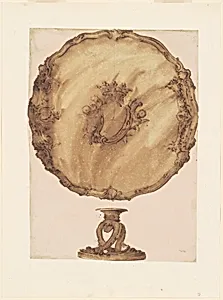
A Salver with Two Bases
1755/1760
Medium
pen and brown ink with brown wash over graphite on laid paper, laid down on an album sheet
Dimensions
sheet: 37 × 27 cm (14 9/16 × 10 5/8 in.) mount: 45.4 × 34.4 cm (17 7/8 × 13 9/16 in.)
Classification
Drawing
Department
CG-E
Museum
National Gallery of Art, Washington, D.C.
Credit
William B. O'Neal Fund
Accession Number
2016.68.1
Rights
Public Domain
Art Historical Context
This delicate drawing by Luigi Valadier captures a design for an elegant silver salver supported by two ornate bases, created between 1755 and 1760. Valadier, a leading Roman silversmith and designer of the late eighteenth century, was renowned for blending Rococo exuberance with emerging Neoclassical restraint. His preparatory works like this one reveal the meticulous planning behind luxury objects commissioned for aristocratic and papal patrons across Europe. Executed in pen and brown ink with subtle washes over graphite, the sheet demonstrates Valadier’s precise draftsmanship. The medium allowed him to explore light, shadow, and three-dimensional form on paper before committing costly materials to metalwork. Such designs were essential in his busy workshop, where ideas for trays, candlesticks, and table services were refined through multiple studies. As both functional object and sculptural statement, the salver reflects the period’s fascination with classical motifs and refined dining rituals. Today the drawing offers visitors a rare glimpse into the creative process behind some of the finest silver produced in eighteenth-century Rome.
About the Artist
Luigi Valadier · 1726–1785
**Luigi Valadier (1726–1785)** was a leading Italian goldsmith, silversmith, jeweler, and sculptor active in eighteenth-century Rome. Born in Rome on February 26, 1726, he was the son of Andrea Valadier, a French-born silversmith who had settled in the city in 1714 and established a successful workshop on via del Babuino. Luigi trained and began his career in his father’s workshop, assuming its di...