
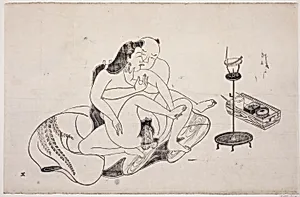
A sheet from a shunga album
1679
Medium
Woodblock print; sumizuri-e
Dimensions
26.6 × 41 cm (10 7/16 × 16 1/8 in.)
Department
Arts of Asia
Museum
Art Institute of Chicago
Accession Number
193727
Rights
Public Domain
Art Historical Context
This captivating sheet from a *shunga* album, produced in 1679, offers a glimpse into Japan's vibrant Edo-period print culture. *Shunga*, meaning "pictures of spring," refers to erotic woodblock prints that were both artistic masterpieces and private indulgences, enjoyed across social classes despite their discreet circulation. Created as part of an album, this 26.6 × 41 cm sheet early ukiyo-e traditions, capturing fleeting pleasures with bold intimacy. Rendered in *sumizuri-e*—a sophisticated monochrome woodblock technique using black ink (*sumi*) on rice paper—this print highlights the artist's mastery of line, shading, and negative space. Before the advent of vibrant multicolored *nishiki-e* prints in the 1760s, *sumizuri-e* relied on nuanced ink densities and subtle *barenzuri* (hand-coloring with mica) to evoke sensuality and depth, making every curve and gesture strikingly expressive. Held in the Art Institute of Chicago's Arts of Asia department, this anonymous work underscores *shunga*'s cultural role: not mere titillation, but a celebration of human connection, fertility, and humor in Japanese folklore. Its preservation reveals how these "forbidden" images influenced global art appreciation, blending eroticism with exquisite craftsmanship.
About the Artist
Unknown
The artist designated as "Unknown" in our virtual museum's collection exemplifies a poignant chapter in art history: creators whose identities have faded into obscurity despite the enduring power of their work. With only one known artwork attributed to them in our holdings, this figure represents countless anonymous hands that shaped visual culture across centuries. Museums worldwide, including th...