
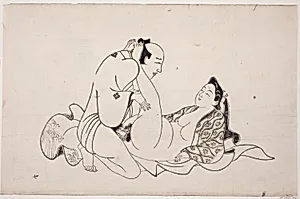
A sheet from a shunga album
1679
Medium
Woodblock print; sumizuri-e
Dimensions
26.6 × 41.4 cm (10 7/16 × 16 5/16 in.)
Department
Arts of Asia
Museum
Art Institute of Chicago
Accession Number
193730
Rights
Public Domain
Art Historical Context
This woodblock print, created in 1679, belongs to a shunga album—a traditional Japanese genre of erotic art that flourished during the Edo period. Shunga, meaning “spring pictures,” celebrated human intimacy with a blend of playfulness, beauty, and poetic suggestion. Produced as sheets within albums, these works were meant for private viewing and often paired images with witty captions or poems, reflecting the era’s open cultural attitudes toward sensuality. The medium of sumizuri-e, rendered solely in black ink, highlights the early mastery of woodblock printing techniques. Before the advent of multi-color printing later in the 18th century, artists relied on precise line work and tonal variation to convey depth, texture, and movement. This monochromatic approach lent the composition a graphic elegance, emphasizing form and narrative over vivid color. Housed in the Art Institute of Chicago’s Arts of Asia collection, this sheet offers a window into 17th-century Japanese print culture. Its modest dimensions and album format underscore how such works were designed for intimate appreciation, preserving both artistic skill and the social customs of their time.
About the Artist
Unknown
The artist designated as "Unknown" in our virtual museum's collection exemplifies a poignant chapter in art history: creators whose identities have faded into obscurity despite the enduring power of their work. With only one known artwork attributed to them in our holdings, this figure represents countless anonymous hands that shaped visual culture across centuries. Museums worldwide, including th...